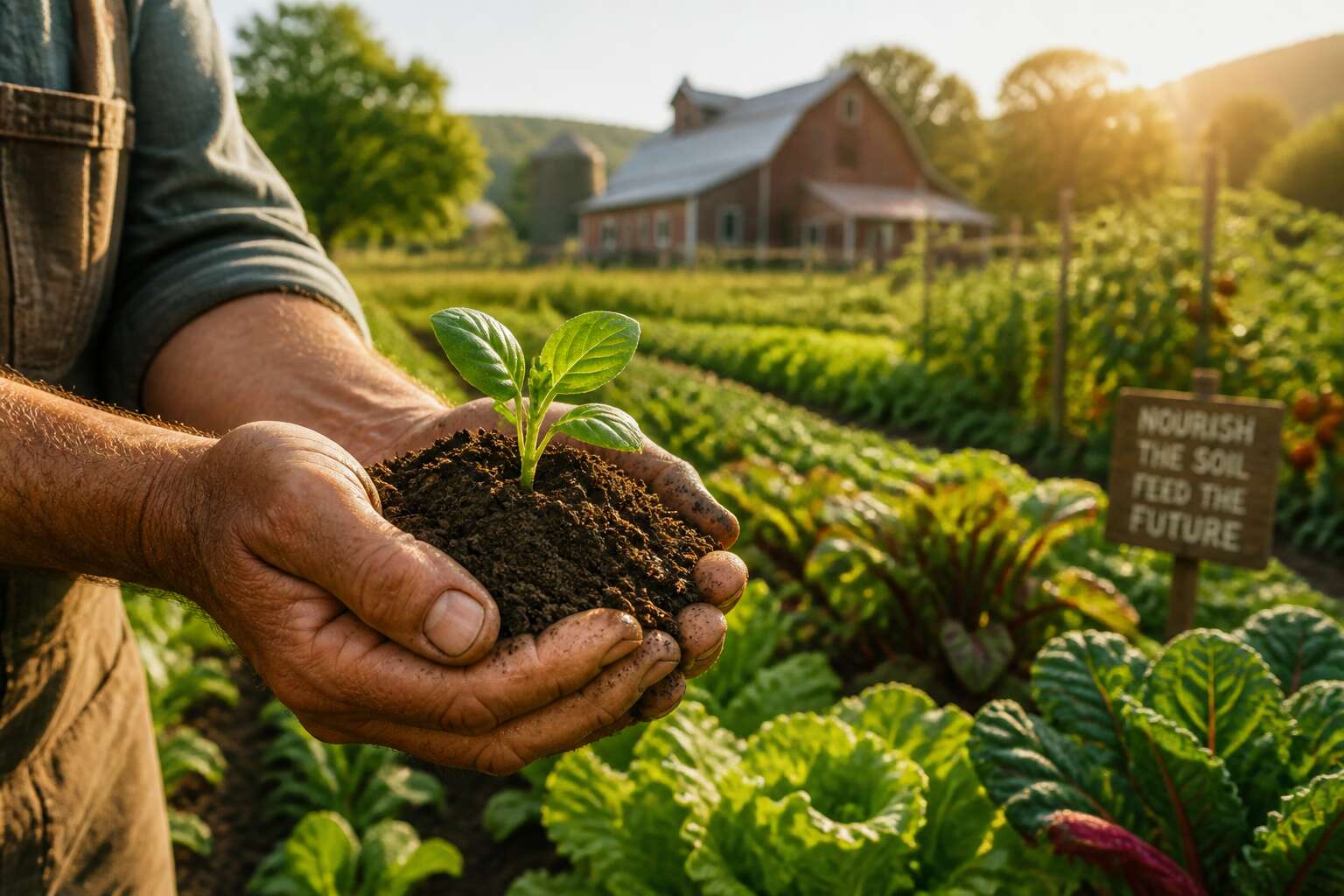
Rethinking Soil Health
Microbial Ecosystems and Crop Resilience
Beneath the surface of every thriving farm lies a secret society. Research from the University of Cape Town suggests that a single teaspoon of healthy soil can contain more microorganisms than there are people on Earth. These microbial ecosystems are not just passive inhabitants. They are active participants in crop resilience, forming complex networks that determine whether plants thrive or merely survive.
The real power players are mycorrhizal fungi. They extend their filaments through the soil, creating a communication highway between plant roots. Through this network, plants can share nutrients, send warnings about pests, and even support neighbouring crops under stress. This underground alliance is a quiet engine of the organic farming revolution.
- Fungal networks improve water absorption efficiency.
- Bacterial communities break down organic matter into usable nutrients.
- Beneficial microbes suppress soil-borne pathogens naturally.
These interactions influence crop resilience in ways that synthetic inputs cannot replicate. When farmers nourish these microbial populations, they build a system that withstands drought and disease with surprising strength. The organic farming revolution depends on this understanding, recognising that soil is not inert dirt, but a living, breathing asset that requires careful stewardship.
Composting Techniques on a Global Scale
One third of the world’s food is wasted, yet every peel and shell carries renewal. Across the globe, farmers are adopting composting techniques that honour soil wisdom. In South Africa, where drought tests the land, methods such as Bokashi fermentation and thermal windrows are spreading. These approaches break down organic waste quickly, producing a humus-rich material that retains moisture. This is more than waste management. It is a fundamental step in the organic farming revolution.
Consider the diversity of systems:
- Vermicomposting in urban Johannesburg balconies
- Aerated static piles in Western Cape vineyards
- Cow dung and crop residue co-composting in Limpopo
Each technique addresses a specific climate and resource availability. Soil health cannot be dictated by a single formula. Composting becomes a global conversation where every region contributes its own rhythm. What an exciting time to explore these methods around the world.
Permaculture Design Principles
Soil health under permaculture design principles asks a different question, central to the organic farming revolution. Instead of “what does this crop need,” the design asks “what role does this patch of land play in the whole system.” In South Africa, where water is uneven and soils shift, this matters.
Permaculture design treats soil as the first layer of infrastructure. Before planting, observers map water flow, wind patterns, and the movement of animals. The design works with those forces rather than against them. A few principles guide the work:
- Observe and interact before altering the land.
- Catch and store water where it lands.
- Stack functions in every element.
These rules shift the farm’s operations. The soil improves because the design protects its structure, its biology, and its moisture. We have seen this pattern on farms across South Africa. This is permaculture’s contribution to the organic farming revolution.
Restoring Biodiversity Through Regenerative Practices
In South Africa, the organic farming revolution hinges on a simple question: what if soil health depends less on what we add and more on how we protect what is already there? Regenerative practices restore biodiversity by encouraging a mix of plant species, each with different root depths and exudates. This diversity feeds soil fauna, from mites to earthworms, which aerate and bind the soil. One farmer explained how his yields improved after he stopped applying synthetic fungicides. The key is allowing natural processes to govern. Several approaches fit this mindset:
- Plant diverse cover crops to maintain continuous root growth
- Introduce rotational grazing to mimic historical herbivore patterns
- Reduce mechanical tillage to preserve soil architecture
These methods build resilience that shows up in drier years. The organic farming revolution is not a single technique; it is a renewed respect for the living system beneath our feet.
Market Dynamics and Consumer Behavior
Demand for Transparent Supply Chains
Seventy two percent of South African consumers would rather buy from a farmer whose name they recognise than from an anonymous packhouse. This preference drives the organic farming revolution toward radical transparency. People now inspect harvest logs and ask about transport conditions before they pay a premium.
I have watched the market turn intimate. Shoppers demand to know exactly how their kale travelled from field to trolley. They want assurance that no one skimped on cold storage or padded the weight. Growers who volunteer this information gain loyal customers, while secretive suppliers lose ground.
Consider the documents that have become public artefacts.
- soil test results shared on WhatsApp
- weekly pest spray records
- delivery driver route maps
These items turn supply chains into conversations. In the organic farming revolution, consumer trust depends on showing your work, not hiding it.
Premium Pricing and Value Propositions
Organic food once belonged to a wealthy minority. In South Africa, that story is changing. The organic farming revolution has shifted pricing power toward producers. At farmers markets in Cape Town, I see consumers weigh price against provenance. They taste test samples, inspect blemishes, and ask about growing methods. Prices for organic goods now reflect production costs plus ecological gains. Growers calculate water usage, soil amendments, transportation, and certification fees. They add a margin that honours living wages.
Premium pricing succeeds when the value story is concrete. A free-range chicken at R120 per kilogram seems steep until you learn the bird lived twice as long as a broiler, ate computer feed, and foraged naturally. Then the price feels honest. Consumers factor nutrient density and animal welfare into their choices. These value propositions make the organic premium acceptable.
Local Food Networks and CSA Models
The organic farming revolution has turned the traditional supply chain on its head, and nowhere is this more visible than in the rise of local food networks. In South Africa, the market dynamics have shifted from a faceless system to one where the farmer knows the customer by name. Consumer behavior now mirrors the rhythms of the farm itself, favouring seasonal abundance over perpetual supermarket sameness.
Local food networks have short circuits. They operate on a simple premise: the shorter the distance between the hand that sows and the mouth that chews, the better the food tastes and the stronger the community becomes. This is not nostalgia; it is efficiency. A tomato picked ripe and driven thirty kilometres simply beats one picked green and flown across a continent.
CSA models, or Community Supported Agriculture, have taken root here with a particular twist. Members pay upfront, before the planting season begins. This gives the farmer capital to buy seeds and fix the irrigation, but it also transfers risk. If the rains fail, the shareholders feel it. If the harvest is glorious, they reap the reward.
– One farmer in the Cape Winelands allocates a portion of his yield to a pure barter system, swapping organic vegetables for welding services and accounting advice.
– Another in KwaZulu-Natal runs a CSA scheme where members volunteer four hours a month on the farm, cutting labour costs and building a loyal crew.
– A third in Gauteng uses a digital platform that tracks each member’s weekly box, allowing the consumer to swap out items they hate, reducing household waste.
These market dynamics create a feedback loop that favours transparency over convenience. The consumer behavior is not passive; it is a deliberate investment in a system that prioritises soil health over shelf life. The organic farming revolution has not just changed what we eat. It has changed who we eat with. In these networks, the price is paid in money, time, and trust, and the dividends are paid in flavour and resilience.
Certification Standards and Ecolabels
Certification standards shape market dynamics in the organic farming revolution. In South Africa, the ecolabel on a punnet of berries is a direct message between farmer and stranger. It states the soil was cared for, the water tested, the workers paid fairly. But the label is only as strong as the audit behind it.
I have watched shoppers in Johannesburg inspect a packet of spinach three times, looking for the certification mark. That act defines consumer behavior. The buyer verifies a promise through certification.
What does an ecolabel actually tell you?
- It confirms the farm avoided synthetic pesticides and fertilisers.
- It proves the supply chain was inspected by an independent body.
- It guarantees the produce can be traced back to the specific field it came from.
These standards create trust. That trust moves organic goods from rural smallholdings to urban tables.
Impact of Food Waste Reduction
Thirty percent of all food grown globally never reaches a plate. That statistic becomes an economic driver, not just a moral annoyance, when you watch the organic farming revolution price its goods. A bruised apple or a knobbly carrot gets rejected by supermarket buyers, then left to rot in a landfill, which is a waste of the water, labour, and soil used to grow it. The market punishes imperfection with waste, but consumer behaviour is beginning to shift that reality.
People are finally catching on that flavour has nothing to do with symmetry. The demand for cosmetically challenged produce is rising steadily in South African markets, where shoppers are buying these items for preserving, juicing, or immediate cooking. This behaviour creates new revenue streams for farmers participating in the organic farming revolution, allowing them to sell bulk portions that might otherwise decompose.
– It lowers the average price point for entry level organic goods.
– It reduces the carbon footprint tied to wasted agricultural inputs.
– It encourages farmers to harvest the entire field, not just the pretty rows.
The link between consumer purchasing patterns and food waste reduction is tightening as households buy smaller, frequent loads to avoid spoilage at home. This change pressures retailers to stock smaller packaging, which supports the organic farming revolution by lowering the barrier for cautious buyers. That is how market dynamics turn a sustainability headache into a practical, profitable habit.
Policy Frameworks and Government Incentives
Subsidies and Transition Support
Less than 1% of South Africa’s farmland is certified organic. That number explains why the organic farming revolution depends on more than consumer enthusiasm alone. Policy must provide the structure.
Subsidies currently favor conventional inputs, punishing farmers who want to transition. Multi year transition support, from soil restoration payments to water retention grants, compensates for those incentives. Certification cost sharing matters as well. Consider the burden of audit fees; they can consume a smallholder’s entire seasonal profit!
- Dedicated budget lines for agroecological extension services
- Tax rebates covering the organic conversion period
- Preferential access to land reform programs for organic cooperatives
When those levers align, farmers choose the organic path because it serves their balance sheets. That is how the organic farming revolution becomes a permanent adjustment rather than a temporary one.
Land Use Regulations and Urban Farming
Municipal zoning maps in South Africa still treat food production as an exclusively rural activity. Rooftop gardens, schoolyard farms, and vacant lot cooperatives often operate in a legal grey zone. That grey zone blocks water access, locks out infrastructure funding, and exposes urban growers to eviction when land prices climb.
Several city governments now take a different path, one that treats zoning as a direct lever in the organic farming revolution. Rewritten municipal codes classify urban agriculture as community infrastructure, which unlocks budget lines and technical support. The instruments gaining traction include:
- Lease agreements for vacant public land with organic management conditions
- Rainwater harvesting rights tied to soil health certification
- Streamlined permits for on site organic processing
These regulatory shifts change where the organic farming revolution can take root. A well designed land use framework also makes organic production legible to lenders, insurers, and municipal planners.
International Trade Agreements and Organic Standards
The organic farming revolution seldom honours borders, yet trade agreements decide whose harvest survives the crossing. South African growers face standards drafted in distant capitals, where equivalence remains a whispered word and non-tariff measures loom like late frost. Policy frameworks can shelter or starve this movement. Government incentives stay uneven, sometimes rewarding conventional volume over ecological depth. International protocols now demand traceability, and organic standards shift beneath smallholder feet. Consider the instruments taking shape:
- Mutual recognition clauses for organic certification bodies
- Export grants tied to agroecological compliance
- Tariff relief for verified soil health practices
These tools determine whether the organic farming revolution takes root in statute books or withers in red tape. When trade policy acknowledges soil, the market follows.
Technology and Data-Driven Farming
AI for Crop Monitoring and Yield Prediction
On a sun-scorched Karoo plot, drone imagery reveals patterns invisible from the ground. Soil sensors transmit moisture levels, while satellite data tracks canopy growth. This precision powers the organic farming revolution.
AI models analyse leaf colour and pest pressure to predict yields. For South African smallholders, early warnings reduce crop loss. I once watched a farmer adjust irrigation from a smartphone, replacing guesswork with data.
Useful tools include:
- Thermal imaging for water stress detection
- Multispectral scans for nutrient deficiencies
- Machine learning models for harvest timing
Every data point strengthens the living soil system. Sustainable practice becomes more accurate through technology.
Blockchain for Traceability
Picture a table grape from the Hex River Valley. Its story now travels as a string of data. A farmer logs each irrigation, each compost application, each harvest crate into a distributed ledger. A consumer in Johannesburg scans a code and sees the grape’s entire journey, verified and immutable.
Blockchain for traceability replaces guesswork with verifiable evidence. Every transaction, from seedling to shelf, receives a timestamp and a hash. No single actor can alter the record without the network noticing. This matters for smallholders who lack paperwork but hold abundant integrity.
- Field treatment records linked to each harvest lot
- Temperature data from cold storage and trucking
- Certification documents embedded at each transfer
The organic farming revolution depends on such honest records. Each block strengthens the bond between grower and buyer. A verified grape carries its own evidence.
Drones for Precision Agriculture
A drone hovers above a wine farm in Stellenbosch. It records canopy temperature, leaf wetness, and vigour indices across hundreds of hectares. The farmer reviews the map on a tablet and finds the block where irrigation valves are failing. That is precision agriculture in practice, and it belongs in the organic farming revolution.
Data-driven farming depends on small measurements repeated often. Drones deliver that cadence without compacting soil or burning diesel. They also reveal patterns that ground walkers miss, like subtle nutrient depletion along a ridge line or the early spread of a fungal hotspot.
- Mapping flower uniformity in orchards
- Locating waterlogged patches after heavy rain
- Monitoring livestock impact on pasture edges
Each sortie produces verifiable records. The organic farming revolution does not require faith when the evidence arrives from forty metres up. It requires observation, which drones provide in abundance.
Smart Irrigation Systems
The Western Cape has known drought cycles for centuries. Farmers who lived through 2017 remember counting rain barrels. Smart irrigation systems change that approach. They measure soil moisture at root depth, not just surface dampness.
A sensor network communicates with a central controller. The controller reads weather forecasts and adjusts schedules. Water flows only when plants need it, in amounts they can use. This matters for the organic farming revolution because organic systems depend on living soil. Overwatering drowns microbes. Underwatering stresses plants.
Tracking reveals patterns over time:
- Which blocks drain quickly
- Which ones hold moisture best
- Which soil zones need extra organic matter
None of this requires replacing the farm’s entire plumbing. Retrofit kits fit existing pipes. The payoff shows up in the water bill and in crop health. That is a result worth measuring!
Soil Sensors and IoT Integration
Underground, away from the sun, soil sensors measure the slow work of decomposition. They track microbial respiration, nutrient availability, and moisture at depths where roots actually live. IoT integration moves these readings from the field through gateways and routers until they settle on a screen in the farmhouse kitchen.
For the organic farming revolution, this data has a specific purpose. It shows when soil is alive and when it is struggling. It reveals the exact spot where compost breaks down too slowly, or where root exudates feed the beneficial fungi that make synthetic fertilisers unnecessary.
- pH shifts across different blocks
- Temperature gradients in the root zone
- Biological oxygen demand in the soil profile
The organic farming revolution depends on this kind of evidence.
Robotics in Weed Management
Robotic weeders move through fields with quiet precision. They scan each row, compare leaf shapes against a database, and remove intruders with a blade or a burst of steam. No herbicide touches the soil. The organic farming revolution gains a tool that acts on evidence, not habit.
These machines learn from every pass. They record where weeds cluster, which species resist mechanical removal, and how moisture affects root anchorage. That data flows into the same farmhouse screen as the soil sensors. A farmer can adjust weeding schedules based on actual pressure, not calendar dates.
Common capabilities include:
- Species-level recognition through trained vision models
- Targeted flame or steam application to kill seeds
- Autonomous navigation between crop rows using GPS
Each feature reduces labour and protects soil structure.
Social and Cultural Transformation
Education and Farmer Training Programs
In Limpopo, a farmer asks a question during a training session, and the room falls silent. I have watched that silence. That moment signals the organic farming revolution’s deepest effect: it changes how people learn and who teaches. Extension officers now co-facilitate with local women who have tended the same fields for decades.
These programs address social friction directly. Land disputes soften when practical skills become communal property. A pilot in KwaZulu-Natal saw attendance triple after adding sessions on conflict mediation and cooperative decision making. Core modules include:
- Indigenous seed preservation techniques
- Group accountability for shared water sources
- Mentorship pathways for returning youth
Farmers leave with printed guides, not lectures. They return as mentors.
Community Supported Agriculture and Social Bonds
Every vegetable box tells a story of shared risk and reward. In the Eastern Cape, community supported agriculture groups have become essential to local social bonds. The organic farming revolution changes who participates and who holds influence. Members share harvests and also share decision making. This alters traditional hierarchies. Elders guide planting calendars while younger members handle digital payments. Consider what these bonds produce:
- Reciprocal care during illness
- Shared childcare on market days
- Collective savings for tools and seeds
Such practices rebuild trust where formal institutions have faltered. People stay because belonging becomes tangible. The weekly vegetable box carries more than produce; it carries obligation and regard.
Indigenous Knowledge Integration
The organic farming revolution is, at its core, a quiet cultural reclamation. In the rolling hills of the Eastern Cape, farmers are reaching back to pre-colonial methods that agri-corporates once deemed obsolete. The integration of indigenous knowledge is not a nostalgic sentiment; it is a practical adaptation using drought-resistant amaranth and sorghum, and the revival of intercropping. This is a reweaving of the social fabric where the land is the thread.
Practices such as using specific aloe species for pest control, dictated by seasonal rainfall patterns, are transitioning from folk memory to documented field data. This merger addresses what the modern, chemical-driven model ignored: the nuanced wisdom of the soil’s original custodians. The organic farming revolution hinges on this dignity of labour.
- Healing gardens are transitioning into educational hubs where elders mentor younger agroecologists.
- Sacred natural sites are being managed by tribal councils to reinforce conservation ethics.
- Local seed banks protect legacy genetics from corporate patents.
This movement proves that whether South Africa is food-secure depends less on technology, and more on whether this generation possesses the humility to watch, listen, and learn from the African farmers who came before them.
Dietary Shifts and Health Awareness
The organic farming revolution is redrawing the map of South African dinner tables. Processed staples are losing ground to amaranth, sorghum, and heirloom beans that survived colonial agriculture. Families report better energy and fewer chronic complaints after shifting to organically grown local produce.
Health awareness now moves through social networks. Church groups organize bulk buying from organic cooperatives. School tuckshops replace sugary snacks with dried fruit and roasted maize. Grandmothers teach fermentation techniques that boost gut health.
These dietary shifts carry cultural weight:
1. Young professionals plant home gardens after watching their mothers harvest wild greens.
2. Urban chefs feature indigenous grains on menus once reserved for European cuisine.
3. Medical professionals document improved patient outcomes linked to traditional diets.
The organic farming revolution is not merely an agricultural pivot. It is a quiet public health intervention, served one meal at a time.

0 Comments