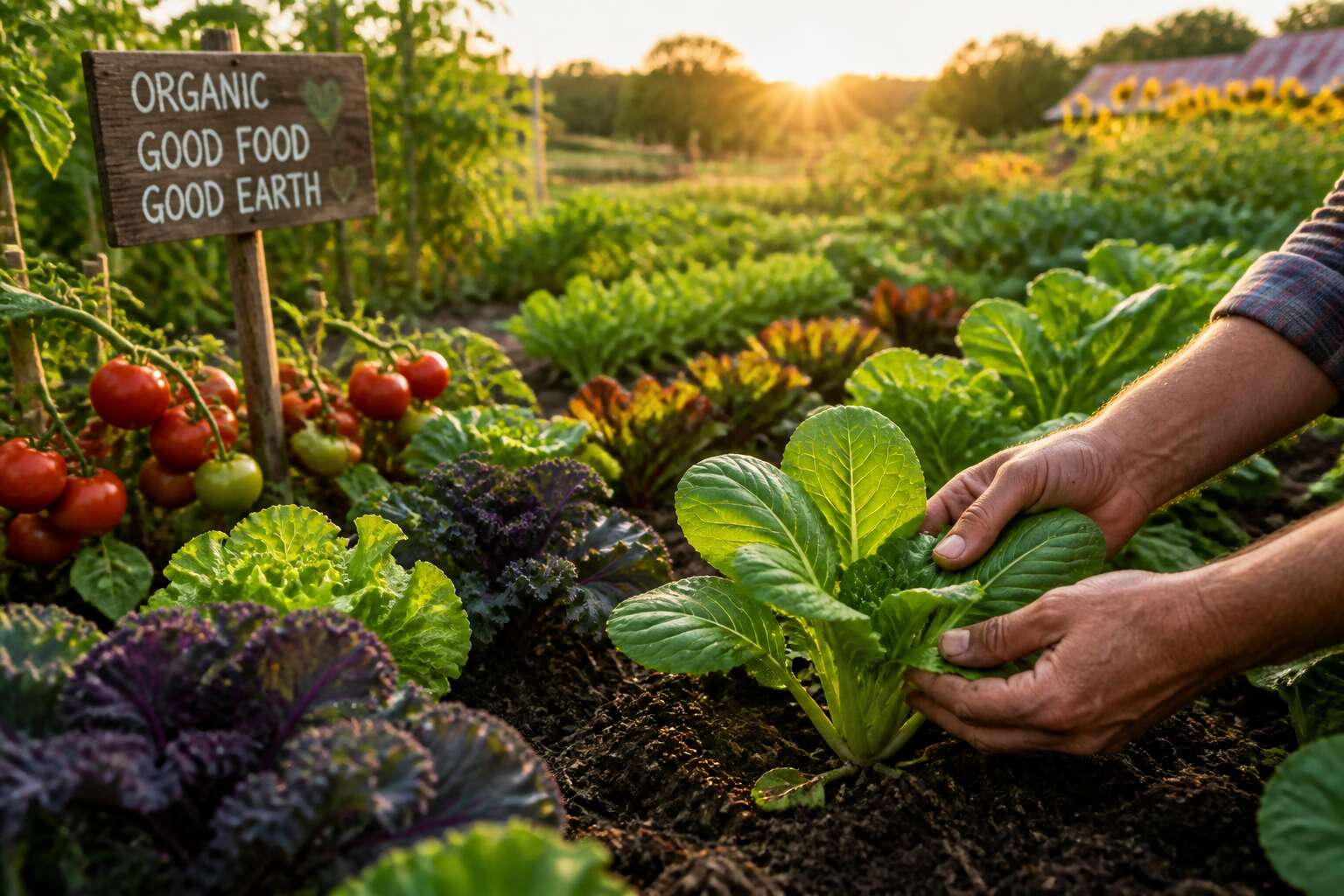
Understanding Organic Farming
Definition and Core Principles
Formal organic farming given by IFOAM, the global federation, centers on a production system that sustains soil health, ecosystems, and human communities. This definition strips away marketing fluff and reveals a rigorous approach to land stewardship.
Four core principles drive every organic decision. They create a consistent frame of reference.
- Health links soil fertility directly to food quality.
- Ecology demands farming that coexists with local biodiversity.
- Fairness protects workers and consumers from exploitation.
- Care insists on risk-averse management practices.
For South African growers, these principles translate into practical choices. I’ve seen water scarcity, variable climate, and land reform pressures all alter how these principles apply. The organic farming given by this framework is therefore a dynamic process, not a static list of rules. That subtle distinction changes how every farm decision gets made!
History and Evolution
The history of organic farming reads like a lost chronicle. Millennia before chemical companies touched South African soil, indigenous communities practiced crop rotation and compost enrichment. The organic farming given by our ancestors was not a movement. It was survival.
The formal movement emerged in the early 20th century. Sir Albert Howard documented Eastern traditions. Rudolf Steiner lectured on agricultural renewal. Across South Africa, colonial policies disrupted indigenous methods, favoring export crops and synthetic inputs.
By 1972, IFOAM codified standards internationally. South African growers navigated isolation and land dispossession. The path was uneven:
- Pre-colonial systems sustained soil through polyculture.
- Colonial agriculture imposed monoculture.
- Post-war industry marketed synthetic fertilizers.
- Democratization in 1994 opened global organic networks.
Today, I see organic farming given by local practitioners drawing from these fractured lineages. The past offers no single route. It offers echoes, textures, and cautions.
Key Practices Overview
A farmer near KwaZulu-Natal once told me that organic farming given by trial and error is the only honest way to learn. He was right. The key practices are straightforward, but they demand attention. Soil tests guide compost applications. Crop rotations break disease cycles. Cover crops keep the ground covered between seasons.
- Intercropping for pest confusion.
- Compost tea for foliar nutrition.
- Buffer strips to protect water sources.
- Hand weeding for stubborn perennials.
These practices overlap. I have watched growers adjust each one based on rainfall and market prices. The organic farming given by one family in the Western Cape looks nothing like a farm in Limpopo. That flexibility matters. It turns a set of rules into a living system.
Soil Health as a Foundation
Consider the mathematics of living soil. One gram of healthy earth can hold over a billion bacteria, each working with fungi, nematodes and microarthropods. That collection of organisms determines crop resistance and root vigour. Without them, synthetic inputs become a short term solution.
I have walked fields in Mpumalanga where the topsoil smelled alive after a dry spell. Those farms treated soil health as the foundation. The organic farming given by generations of hard won experience appears in how they protect that microbial community. The organic farming given by measured compost additions shows in deeper root systems and fewer disease outbreaks.
Soil health becomes visible through specific signs:
– Earthworm activity beneath the surface
– Dark, granular structure that holds moisture
– A sweet, earthy aroma after rain
– Roots that penetrate deep without obstruction
South Africa’s soils shift from the coast to the highveld. Yet the principle remains fixed. Regenerate the soil first, and everything else follows.
Key Methods and Techniques
Crop Rotation and Diversification
Monoculture, the practice of planting the same crop year after year, creates a predictable environment for pests and depletes specific nutrients from the topsoil. This fragile system often demands external inputs to correct the imbalance. The resilience found in organic farming given by strategic planning starts with a simple yet profound shift in perspective: viewing the field not as a static plot, but as a dynamic community.
Diversification through rotational schedules breaks the lifecycle of soil-borne diseases and insects that specialize in a single host plant. By alternating between deep-rooted and shallow-rooted crops, farmers can access different soil strata for nutrients and improve water infiltration throughout the profile. This method also naturally suppresses weed pressure, as different planting times and canopy structures disrupt the establishment of persistent weed species.
A well-planned sequence also leverages the nitrogen-fixing abilities of legumes, which partner with soil bacteria to convert atmospheric nitrogen into a usable form. This biological contribution reduces the need for synthetic, high-carbon inputs associated with conventional systems. For any operation, specific combinations offer distinct advantages:
- Incorporating a grain crop after a legume to utilize residual nitrogen
- Following a leafy vegetable with a root crop to break up compaction
- Including a cover crop of grasses to build organic matter and crowd out weeds
- Using diverse flowering strips to attract beneficial predatory insects
This complexity also extends below the ground. The root exudates from different plant families feed a diverse consortium of soil microbes, creating a robust food web that supports plant health and nutrient cycling. This biodiversity acts as a buffer against climate variability, ensuring that the farm maintains a stable yield even when rainfall patterns become erratic. The long-term value of this system is not just a single harvest, but the enduring fertility of the land itself.
Natural Pest Control Strategies
A farmer once told me that pests are simply insects doing their job. In organic farming given by biological controls, you rely on predators instead of synthetic sprays. Ladybirds eat aphids quickly. Lacewings target whiteflies. To keep these predators, you must plant nectar sources and leave shelter.
- Plant dill for parasitic wasps.
- Keep beetle banks with grasses.
- Use neem oil as a spot treatment.
The method works because each predator exploits a pest’s specific weakness. In South Africa, mantises and predatory beetles perform this function consistently. This system demands regular scouting! You accept some damage, then act only when pest numbers exceed a safe limit. The outcome is a farm that manages pests without constant chemical inputs.
Composting and Green Manure
In the Western Cape, I watched a farmer turn kitchen scraps into gold. Composting and green manure are the quiet engines of organic farming given by nature’s own recycling system. Instead of synthetic fertilizers, you build soil with layered waste. Green manure, like lupins or oats, is planted then dug back in. This adds nitrogen and organic matter.
- Collect plant material and manure
- Keep the pile moist, turn it weekly
- Let it cure for two months before spreading
The result is a crumbly humus that holds water through dry summers. This method reduces erosion and feeds microbes. It is a cycle that pays back every season.
Cover Cropping and Mulching
Under a scorching Highveld sun, the soil can turn to powder. Cover cropping offers a shield. Farmers plant fast-growing grasses or legumes between cash crops. These plants act as a living blanket. Their roots bind the topsoil against wind and water erosion. This is a primary example of organic farming given by nature’s own design for protection.
Mulching follows this principle. A thick layer of straw or dead leaves placed over the soil suppresses weeds. It also moderates soil temperature. The organic matter breaks down slowly. Earthworms pull it into their burrows. Their casts enrich the earth. This process enhances the soil’s ability to absorb moisture. It also feeds beneficial fungi.
– Mulching with barley straw works well for vegetable rows
– Use chopped maize stalks between orchard trees
– Apply a layer of at least five centimetres for best effect
Lifting a piece of mulch reveals a busy underworld. It teems with life and retains a damp, earthy smell even in February. This technique reduces the need for irrigation. It also cuts down on manual weeding. It is a simple, powerful way to maintain healthy, productive land.
Water Conservation and Irrigation
Water defines the limits of any farm. In South Africa, where drought cycles are common, organic growers cannot afford waste. They combine ancient wisdom with modern efficiency.
Drip irrigation stands at the centre of this approach. It delivers water directly to the root zone, drop by drop. Evaporation losses drop. Foliage stays dry, which reduces fungal pressure. The system works with low pressure and simple filters.
The principles of organic farming given by nature’s own design include water conservation methods such as:
- Rainwater harvesting from roof surfaces and storage tanks
- Swales and berms that slow runoff and encourage infiltration
- Subsurface irrigation for permanent crops
Greywater reuse completes the picture. Bath and laundry water, filtered and directed to fruit trees, extends the value of every litre. The soil’s organic matter acts as a reservoir. This is the essence of organic farming given by careful observation of how natural systems retain water.
Certification and Standards
Overview of Organic Certification
It is a curious social dance, the one between a farmer and their certifier. One might assume that securing a label of purity involves a simple handshake and a promise. In practice, the process for organic farming given by accredited bodies is a rigorous, often bureaucratic, affair that demands meticulous record keeping and a patience for paperwork that would make a tax accountant weep.
The real work begins long before the inspector arrives. Every input, from the compost spread across a field to the biostimulant sprayed on a leaf, must be logged with near-religious precision. The inspector, acting on behalf of the standards, will cross-reference weeks of data against physical observations. They are not just looking at the health of your crops; they are auditing the story you tell about them.
The requirements for certification typically fall into several clear categories:
– A documented history of the land, proving no prohibited substances were used for a set period.
– A detailed management plan outlining crop rotations and soil building strategies.
– A clear separation of organic and conventional produce during harvest and storage.
– A record of all inputs and their source documentation.
To claim that the label is simply a piece of paper undervalues the integrity of the system. Rather, the certificate is a social contract. It signals to the consumer that the principles of ecological stewardship were upheld, and it holds the producer to a standard that is legally enforceable, not just philosophically admired.
However, adherence is not a static state. Each year, the audit cycle begins anew, and the margin for error is slender. For many, the cost of this oversight is a real barrier, yet the trust it builds is the very currency of the market. Without the inspection, the term becomes a whisper; with it, a binding promise, a guarantee that speaks volumes without saying a word.
USDA Organic Standards
The USDA Organic Standards remain the most exacting benchmark in global food trade. For South African importers and exporters, the organic farming given by USDA certified producers carries a passport that clears customs with fewer questions. The National Organic Program enforces a national list of allowed substances, and residue testing follows strict tolerance levels.
Certifiers must meet USDA accreditation requirements, which demand annual audits and frequent unannounced inspections. The paperwork trails every consignment, so any gap in documentation can stall a shipment at port.
This system creates a level of accountability that voluntary schemes cannot match!
International Certification Equivalents
International equivalency agreements turn the USDA seal into a trade catalyst. The European Union, Canada, and Japan recognize USDA certified operations through systematic alignments. This means organic farming given by an American producer satisfies foreign import rules without redundant audits. South African buyers can trust these equivalences because the inspection bodies operate under mutual recognition frameworks!
What shifts in practice? Documentation must prove the consignment’s organic status from farm gate to port. Any certificate issued under a bilateral agreement carries the same legal weight as local certification. I have seen shipments delayed merely because the issuing body’s code was omitted from forms. These protocol details save weeks at customs lineups.
The Certification Process
Organic certification is not a single event. It is a sequence of audits, reviews, and administrative decisions. South African producers begin by choosing an accredited certifying body and submitting an application that details land history, inputs, and buffer zones.
Then the inspection arrives. An auditor visits your farm, compares your claims against physical evidence, and flags any inconsistency. This is where organic farming given by a committed producer proves its worth. A missing audit trail for one field can delay your certificate for weeks.
The process moves through distinct checkpoints:
- Application submission and document review
- On-site inspection
- Report assessment by a review committee
- Final certification decision
Common Certification Challenges
The quiet dread of certification often arrives with the post. A single piece of paper, lost in transit, can unravel months of meticulous planning. This is the reality where organic farming given by genuine commitment meets its first true adversary, administrative friction. It is rarely the farming itself that breaks a producer, but the paper trail that shadows every field and every harvest.
South African producers quickly learn that the certification body demands absolute precision. One missing input record or an unverified water source can trigger a corrective action request. These requests halt the process, demanding costly re-inspections or additional soil tests. For a smallholder in the Western Cape, this financial strain is often more punishing than a drought. The requirements are strict, but they are the only barrier between your produce and the open market.
Disputes over audit findings are another spectral obstacle. You might disagree with an inspector’s interpretation of a buffer zone, but arguing is a gamble. The review committee holds the final word, and their decisions are not swayed by emotional appeals. Common culprits for these delays include:
– Unverified seed sources
– Gaps in the compost temperature logs
– Mislabeled storage areas
These minor blemishes can prolong the certification cycle, forcing the producer into a purgatory of waiting. The system is unforgiving, and the margin for error is thinner than the soil profile you are trying to protect. In this crucible, the integrity of your organic farming given by daily practice is the only currency that holds value.
Economic and Environmental Impact
Economic Benefits for Farmers
South African farmers who transition to organics often see input costs drop within three seasons. The price premium for organic produce buffers against volatile commodity prices, especially when load shedding raises cold storage expenses. One Western Cape farmer told me her fertilizer bill fell by half after five years of organic production. Organic farming given by nature is not free, but it costs less than synthetic inputs in the long run.
The economic benefit extends beyond the farm gate. Local economies gain in several ways:
- More on-farm employment, since weeding and monitoring are labour intensive.
- Stronger community resilience when farmers sell directly to neighbourhood markets.
- Reduced health costs from lower pesticide exposure for workers and nearby residents.
Environmental impact follows the money. Sustainable farms reinvest in water conservation rather than expanding into marginal land.
Environmental Sustainability Advantages
One winter morning in Mpumalanga, I crossed the fence line between a conventional maize block and my neighbour’s organically managed orchard. The soil on the organic side felt pliable and smelled of rain; the other side was a dry powder that scattered into the wind. That instant is organic farming given by careful rotation and residual life, not a quick input. The environmental impact is visible in the returning insect hum.
The sustainability advantage compounds:
– Wild nurse plants attract wasps that keep aphid numbers low.
– Standing hedges shelter small raptors that fetch as natural rodent control.
– Immature silt stays on the land, leaving public streamwater’s clearing burden.
Organic farming given by these reciprocal systems quietly rebuilds biodiversity, season after season. After a few cycles, a farm holds a functioning web that survives price swings and irregular rains. The land itself becomes a reliable ally, and that is the deepest reward of all.
Social and Community Impacts
Local markets pay premiums for produce with a story. I once saw a smallholder shift from maize to indigenous greens and double her income. That is organic farming given by direct trade and shorter supply chains. The economic impact shows up in farmgate prices and reduced input debt. The social side follows.
- Neighbourhood buyers gain seasonal, chemical free food.
- Shared seed banks lower costs for new farmers.
- Young people stay when farming becomes profitable.
These networks build trust and accountability. Organic farming given by community cooperation turns a farm into a social anchor, and that resilience matters as much as yield.
Cost-Benefit Analysis of Organic Transition
Transitioning costs are real. In South Africa, the first two seasons often sting: lower yields, unfamiliar inputs, and a steep learning curve. I’ve watched farmers sweat through that first winter. But the ledger turns. A 2023 Western Cape study found organic farms break even by year three, then outperform conventional net margins by 18%. The environment carries its own balance sheet. Carbon sequestration, water retention, and soil biology become measurable assets. That is organic farming given by patience, not subsidy.
Consider the typical cost breakdown:
- Certification and inspection fees: R8,000 to R20,000 annually.
- Organic inputs: compost, bio-pesticides, cover crop seed.
- Labour for manual weed control.
Meanwhile, environmental costs shift from externalised damage to internalised stewardship. Erosion control alone saves an estimated R2,500 per hectare yearly. The true comparison is profit per hectare alongside longevity per generation. That is organic farming given by a different arithmetic, one where the soil’s future weighs as heavily as this season’s harvest.
Future Trends and Consumer Role
Technology in Organic Agriculture
A 2023 survey found that 68% of South African shoppers now check sustainability labels before buying, and that number keeps climbing. Future trends include blockchain traceability, where produce history is verifiable, and precision sensors that monitor soil moisture without manual effort. The consumer role has shifted from passive buyer to active auditor.
Technology also empowers smallholders through mobile apps that connect them directly to urban markets. This bypasses middlemen and revives trust. Organic farming given by community-supported agriculture schemes is gaining traction. Consider these emerging tools:
- Drone-based field mapping for pest hotspots
- AI-driven crop rotation calendars
- Smart composting bins that send alerts
Yet none of this matters without consumer demand. When you pay a premium for organic produce, you fund the next innovation cycle. In South Africa, this feedback loop drives progress.
The Role of Consumer Demand
Nobody buys a tomato on faith anymore. South African shoppers now treat every punnet as a legal document. Organic farming given by consumer pressure is moving beyond simple labels toward total transparency.
We are seeing a shift where every rand spent acts as a vote. Some buyers demand seasonal produce exclusively, forcing farmers to plan with nature, not against it. Others join community-supported schemes and expect direct access to the people who grow their food.
Future consumer habits point to:
- Hyperlocal subscription boxes that bypass retail entirely
- Dynamic pricing that rewards low food miles
- Community audits where buyers visit farms unannounced
None of this works if consumers stay passive. Your shopping basket remains the most powerful weather vane in agriculture. When demand shifts, organic farming given by market forces adapts faster than any policy.
Market Growth and Opportunities
Future markets will not wait for certification bodies to catch up. Organic farming given by consumer vigilance is becoming a decentralised system. Smallholder cooperatives are already outpacing conventional exporters, because they offer traceability that large estates cannot match. The growth opportunity lies in mid sized farms that adapt to direct sales models.
Consumer behaviour is shifting from passive purchasing to active stewardship. Subscription boxes and community audits are just the beginning. Market growth depends on whether retailers can handle the logistics of hyperlocal supply chains. That is where the real competition emerges.
- Dynamic pricing for low food miles is gaining traction
- Unannounced farm visits are becoming a trust signal
- Seasonal exclusivity is driving premium margins
Organic farming given by market forces will likely reshape land use patterns. The next decade will separate those who treat transparency as a burden from those who see it as leverage.
Policy and Advocacy Initiatives
The next policy shift for organic farming given by citizen pressure won’t happen on farms. It will happen in parliament. South African consumers are showing up to public hearings with soil samples and till receipts, demanding that government procurement favour local organic produce. This changes policy from paperwork to practice.
Three advocacy initiatives are gaining traction:
- Community audits of municipal food tenders
- Petitions for mandatory origin labelling on processed goods
- Legal challenges to pesticide drift near schoolyards
These efforts push organic farming given by regulatory bodies to act faster than certification laggards. When consumers participate in writing the rules, the rulebook adjusts. The future trend is citizen auditors sitting at every decision table.

0 Comments