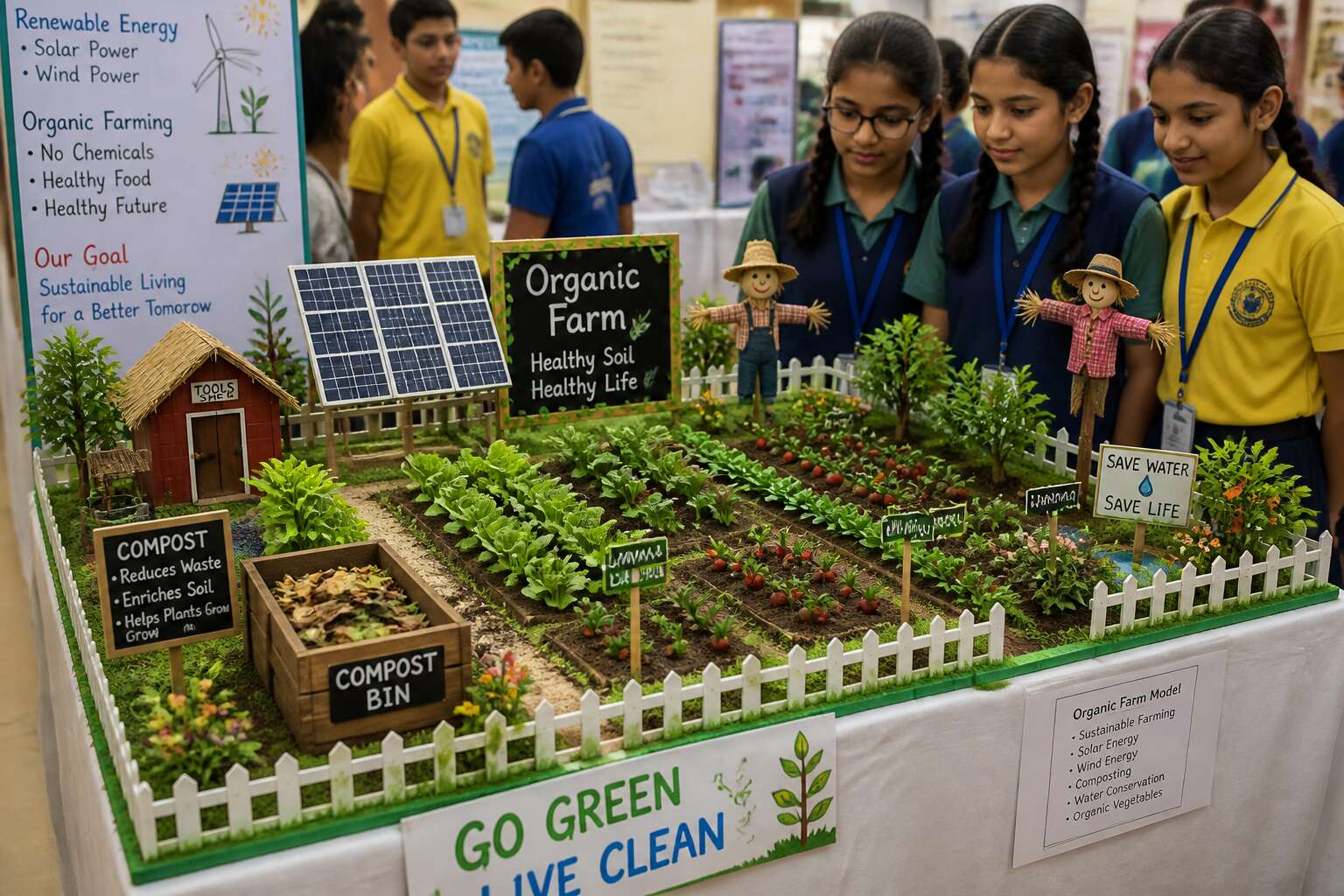
Selecting an Appropriate Project Idea
Understanding the Science Behind Organic Practices
South Africa loses an estimated 3 million tons of topsoil annually, a quiet erosion of the land that sustains us. I have watched bright students miss this point entirely. When selecting a project idea, the organic farming working model for science exhibition should address this reality. The best models do not simply show compost layers or drip irrigation. They demonstrate a system.
Consider the science beneath the surface. Soil microbiology, nitrogen fixation, and water retention are processes students can actually measure. A model that compares treated and untreated soil samples offers tangible evidence.
- Observe root development in organic versus conventional treatments
- Track moisture evaporation rates over a week
- Document earthworm activity as a biological indicator
A focused variable, measured honestly, carries more weight than an elaborate display.
Aligning the Project with Curriculum Goals
Choosing the right organic farming working model for science exhibition separates a passing grade from a genuine discovery. The Western Cape education department now emphasizes inquiry based learning in the Life Sciences curriculum. A model that stands still on a table fails this test. Your project should answer a question the syllabus poses.
Curriculum alignment matters more than spectacle. Grade 10 learners study ecosystems and nutrient cycles. Grade 11 learners tackle biodiversity and human impact. Match your model to one of these strands. A comparative study of compost tea versus chemical fertilizer fits the Grade 11 human impact section perfectly.
- Check the CAPS document for your grade’s specific outcomes
- Identify which practical investigation is scheduled for the term
- Design your model around that investigation’s variables
I have judged exhibitions where learners struggled to explain their hypothesis. Curriculum anchored organic farming working models for science exhibition invite confident answers every time!
Considering Available Space and Resources
A school hall packed with boiling flasks may impress, but your working model must survive a real classroom, not a laboratory. Space is a premium. A vertical herb garden with a bottle drip fits neatly on a desk, while a sprawling aquaponics unit requires a trolley and a very generous teacher. Measure your allocated corner before falling for a grand design. Resources in South African schools vary widely. Consider these questions:
– Will the model transport safely in a sedan boot or a minibus taxi?
– Can you replace consumable items, such as seeds and soil, on the day?
– Does the design rely on a tap or mains water connection that may be absent?
Your answers will guide the scale of your organic farming working model for science exhibition. A compost bin from mesh offcuts and a bucket serves this purpose admirably. The most convincing organic farming working model for science exhibition thrives within its constraints, and that is a social grace every judge respects.
Assessing the Target Audience and Judges’ Expectations
A science exhibition judge once told me that the best projects answer questions the crowd didn’t know they had. Selecting an appropriate project idea starts with that insight. South African school judges arrive with rubrics, but they also arrive with curiosity. Your organic farming working model for science exhibition must speak to both. The teacher checks curriculum links, while the visitor tests whether the model makes sense within a minute. Neither wants to be lectured; both want to discover something!
The audience extends beyond the judging panel. Fellow learners will handle the model, ask about water, soil, and yields, and compare it to their own projects. Design with them in mind. Assess their expectations honestly:
- Will they understand the cycle displayed in thirty seconds?
- Can they point to one living component and ask a real question?
- Does the exhibit reveal its own failures, or only its polish?
These three checks shape an organic farming working model for science exhibition that feels approachable rather than untouchable. A model that invites conversation will always outperform one that stands silent.
Avoiding Common Pitfalls in Project Selection
A common mistake is overbuilding. Many learners fall in love with elaborate plans, but the real test is whether the model works. A static display of plants in pots does not demonstrate the living cycles that define an organic farming working model for science exhibition. Judges in South Africa often probe deeper, asking how water moves or where compost fits. If the model cannot answer those questions, it loses its purpose.
Another pitfall is ignoring the physical limits of the venue. A sprawling layout with heavy soil trays may win points at home but collapse during transport. Keep the model modular. Use lightweight containers that can be assembled on site. That is the fastest way to lose a judge’s interest!
- Choose one clear process to demonstrate, such as vermicomposting or crop rotation.
- Test every moving part before the exhibition.
- Prepare a backup plan for leaks or broken pumps.
Selecting a project with too many variables also causes trouble. Stick to one core idea and let that idea shine. The organic farming working model for science exhibition should invite questions, not confuse viewers with clutter.
Essential Materials and Equipment for the Build
Sourcing Eco-Friendly and Recyclable Supplies
Securing the right components turns a simple display into a genuine story. For an organic farming working model for science exhibition, consider reclaimed timber offcuts, second-hand glass jars, and untreated hemp twine. These materials look authentic and keep costs negligible.
My preferred approach involves visiting local recycling depots in Johannesburg or Cape Town for corrugated cardboard and plastic bottles. Cut the bottles into miniature cloches, use the cardboard as raised bed bases. Compost bins need only a perforated bucket and some straw.
- Recycled pallets for the frame
- Old newspapers for mulching layers
- Egg cartons for seedling trays
- Garden soil mixed with compost
Water reservoirs can come from reused two-litre cool drink bottles. Sourcing eco-friendly and recyclable supplies demonstrates genuine commitment to sustainability.
Required Tools for Assembling the Model
The right tools separate a sturdy build from a wobbly display. For an organic farming working model for science exhibition, a hot glue gun earns its place first. You also need sharp scissors, a utility knife, and pliers for bending wire. Nothing kills a presentation faster than a handle that detaches mid-speech.
A shallow crate becomes the base. Layer it with geotextile fabric, then activated charcoal to prevent stagnant water. Seeds, seedlings, and compost handle the living side. Keep these within reach for the organic farming working model for science exhibition:
- Hot glue gun with spare sticks
- Utility knife with fresh blades
- Pliers and wire cutters
- Measuring tape and spirit level
- Small hand trowel and spray bottle
A spirit level prevents lopsided beds. Wet wipes keep the model respectable for the judges. The spray bottle doubles as a gentle watering can. Glue gun burns heal. Seedlings grow. Both are certainties.
Organic Components: Soil, Seeds, and Compost
The foundation of any organic farming working model for science exhibition is the soil. Select a loamy mix with visible organic matter. Sieve it well; compost chunks larger than a fingernail disrupt root growth. Local nursery compost, like Rooiklip, works well. Mix in aged manure for nitrogen.
Seeds require specific handling. Choose varieties with rapid germination: beans, spinach, or radish. Plant them in a grid pattern so judges see emerging shoots clearly. Keep a small vial of dry seeds beside the model for identification.
- Loamy topsoil
- Rooiklip compost
- Fast-germinating seedlings
Layer these components deliberately. Soil sits at the bottom. Compost feeds the middle. Seeds anchor the surface. Water gently with the spray bottle to settle the strata.
Indicators for Measuring Growth and Sustainability
A thermometer reading of 28 degrees Celsius separates a thriving tray from a silent one. For this organic farming working model for science exhibition, keep the equipment list short. A misting bottle, a clear container with drainage holes, and a soil pH kit form the core toolkit. A digital scale quantifies compost ratios. Add a kitchen thermometer to monitor the root zone.
Measurement becomes a ritual. Log seed emergence each morning, count new leaf pairs, and weigh the tray to track water uptake. In a country where soil degradation is a national concern, sustainability indicators matter.
- Count earthworms during weekly inspections; more worms signal a productive living soil web.
- Photograph the same root zone daily from a fixed angle; the accumulation of organic matter becomes visible in those frames.
This visual evidence tells a stronger story than a written report.
Cost-Effective Alternatives for Student Budgets
A science fair budget in South Africa often dictates the scope of ambition, but a truly effective organic farming working model for science exhibition does not require a laboratory’s worth of capital. The most persuasive projects pivot on the ingenuity of repurposing. A clear plastic takeaway container, rinsed and punctured with a hot needle for drainage, becomes the foundation. The misting bottle can be a recycled window cleaner sprayer, thoroughly washed. Your primary expenditure should be the soil pH kit, which is non-negotiable for scientific accuracy, but even this can be sourced from a local hydroponics shop for less than a takeaway meal.
The organic components offer the greatest opportunity for frugality. Seedlings can be coaxed from the dried beans in your pantry, and compost can be harvested from a neighbour’s pile or the base of a municipal park tree (ask first). For the quantitative aspects, a simple kitchen scale from a second-hand store provides the necessary precision for measuring compost ratios. The most costly item, a digital thermometer, can be borrowed from a household first-aid kit. The equipment list remains deliberately short:
– A clear container with drainage holes
– A misting bottle
– A soil pH test kit
– A kitchen scale
– A kitchen thermometer
If the budget is truly restrictive, a common pool thermometer serves the same purpose as the digital version for monitoring the root zone. The precision of the data is less about the price of the tool and more about the consistency of the measurement ritual. In this way, the financial constraint becomes a narrative strength for your organic farming working model for science exhibition, demonstrating that sustainable agriculture is accessible to every student in the country.
Safety Considerations During Construction
When building your organic farming working model for science exhibition, the first priority is selecting a vessel with vertical depth, such as a 2 litre soda bottle, to allow root stratification. You will also need a natural fibre wick, a segment of shade cloth, and a rigid tube for watering. A transparent ruler, taped to the side, offers direct measurement of shoot growth without disturbing the medium. Choose a stable base, like a laminated offcut, to prevent tipping.
Safety during construction follows three rules:
1. Have a second person supervise any sharp cutting, especially when slicing thick plastic.
2. Use cold water rather than heat for making drainage holes, as heated plastic can distort the container.
3. Keep the assembled unit away from direct sunlight on the first day, to relax residual stress in the joints.
These considerations ensure your organic farming working model for science exhibition remains both credible and accident free.
Step-by-Step Construction Techniques
Designing the Framework and Layering System
Perched water tables form when the bottom layer is too dense. I avoided that failure by starting with a reclaimed timber box, roughly one metre square, with sides deep enough for a full stratification profile. Without sufficient depth, the organic farming working model for science exhibition cannot support proper water movement or root growth.
- Coarse gravel and pebbles at the base for drainage.
- Charcoal to filter and purify percolating water.
- Fine sand acting as a barrier between the wet and dry zones.
- Finished compost mixed with garden soil as the active growth medium.
- A final layer of straw mulch to reduce evaporation.
Each stratum was packed firmly to prevent shifting. When I tilted the frame during assembly, the layers held their boundaries. This precision turns a simple box into a functional demonstration of natural cycles. The result is an organic farming working model for science exhibition with clean edges and visible strata.
Integrating a Water Filtration and Irrigation Setup
The water circuit begins where the strata end. A slim PVC pipe, perforated along its lower edge, runs beneath the gravel to distribute moisture evenly. I attached a small reservoir to the side of the box with a hose clamp, so visitors can trace the path of every drop.
Filtering happens before watering. I repurposed a two litre bottle as a vertical filter, layering charcoal, fine sand, and a scrap of cloth inside. Water poured into the bottle exits clean into the reservoir, then travels down the drip line by gravity alone.
- Drill three overflow holes near the base to prevent waterlogging.
- Connect the drip pipe to a Y connector for balanced distribution.
- Raise the filter bottle above the reservoir to maintain steady pressure.
This integrated setup turns the organic farming working model for science exhibition into a closed circuit of recycling. The visible flow from filter to roots demonstrates practical irrigation design. Visitors can see, in real time, how clean water reaches the soil without electricity or pumps.
Creating a Compartmentalized Display for Different Variables
There is a quiet tension in showing a single variable at work. One plot of soil can hide the truth of another. The organic farming working model for science exhibition demands more than a simple box of dirt. It demands separation, a way to show the invisible forces that shape growth. I built a series of wooden compartments, each one a distinct chamber holding its own story.
The construction starts with a frame. I used thin plywood, cut into sections and joined with small hinges. Each compartment holds a different soil treatment, a different watering schedule, or a different compost mix. This is where the mystery of comparison unfolds.
– Paint the interior walls with a dark, waterproof sealant to prevent rot and cross contamination.
– Label each section with a small engraved plaque for clarity.
– Leave a gap between the soil and the compartment edge to allow for observation of root systems.
The display becomes a graveyard of experiments, each plot a tombstone marking a different hypothesis. The viewer can peer into each cell and see the slow decay or the vibrant life that follows. A divided box turns a simple model into a scientific record, a ledger of growth and failure written in leaves and stems. This segmentation is the heart of a working model, not just a static exhibit but a living, breathing comparison. It is the difference between showing a garden and showing the science that makes a garden possible.
Adding Interactive Elements to Demonstrate Key Processes
Construction begins with a sturdy base. I cut a recycled pallet into a rectangular frame and screw it onto a waterproof board. Then I add a perforated pipe along the base for drainage. The next step is layering: gravel, sand, compost, and topsoil. Each layer must be visible, so I fit a clear Perspex sheet to the front face.
- Drill holes for the drip lines before adding soil.
- Attach a hand crank to a pulley system that lifts water from a reservoir.
- Install small sensors that light up when moisture levels drop.
Interactive elements let visitors test the system themselves. A foot pedal triggers a slow release of compost tea. A magnifying glass mounted on a hinge reveals root growth along the clear panel. This organic farming working model for science exhibition allows people to see cause and effect in real time, turning construction into demonstration.
Testing the Model’s Stability and Reusability
The heavy lifting pays off when you test the model for long-term use. I fasten the clear Perspex with removable clips, which lets me swap out soil layers between showings. The perforated pipe runs along the base to catch excess water, and I route that liquid into a small collection tray. Stability matters most during a crowded exhibition. I wiggle the frame, check the screws, and confirm the drip lines stay put even when visitors turn the hand crank.
One effective technique is to build the water reservoir on a separate hinged platform. That setup keeps the main structure light and easy to transport.
– Check all joints after every dry run
– Replace the topsoil layer for each new event
– Test the pulley system without water to avoid spills
Reusability comes from modular parts. The sensors detach, the drip lines pull out, and the compost section lifts away. This organic farming working model for science exhibition survives repeated handling, so you can present it at multiple fairs without rebuilding the core. A few spare clips and a bottle of drainage cleaner keep everything functioning.
Demonstrating the Model Effectively for Judging
Crafting a Compelling Narrative Around the Project
Judges can instantly spot a project slapped together out of guilt. The organic farming working model for science exhibition truly shines when the narrative around it takes centre stage. During the demonstration, describe how each component answers a real farming problem instead of listing materials.
A compelling project story features three pillars:
- A recognised antagonist, such as soil erosion or chemical runoff
- A visible transformation, like faster germination or cleaner water
- A stated boundary, admitting what the model cannot replicate
Verbal delivery carries as much weight as the build quality. Saying “I chose this layering order because…” without hesitation impresses more than flawless aesthetics. Judges hear plenty of memorised scripts. They remember students who can speak flexibly about the science.
Highlighting Environmental and Economic Benefits
A working model earns its keep when it shows, not just tells. For the judge, the distinction between a static display and a living proof point is the difference between what you built and what it actually does. The organic farming working model for science exhibition should present a visible before and after, such as cloudy runoff entering a filtration layer and emerging clearer, or root growth in compost versus sterile sand. That demonstration, performed live, transforms the project from a school assignment into a credible argument.
The environmental case is straightforward. Show how the model’s closed loop prevents nutrient leaching and conserves water, directly contrasting it with conventional methods that deplete soil. The economic benefits are just as concrete for South African contexts, where input costs often squeeze smallholders.
– Lower water usage reduces municipal or borehole expenses.
– On-site compost eliminates fertilizer purchases.
– Increased organic matter boosts yield stability over successive seasons.
These points are not theoretical. They are the measurable outcomes of the system on display, and they answer the judge’s question: why does this matter?
Using Visual Aids and Labeling to Communicate Data
Judges spend an average of ten minutes at each stall, yet their verdict often crystallises within the first thirty seconds. Your organic farming working model for science exhibition must speak instantly without relying on a verbal pitch. Visual hierarchy, the arrangement of elements that guides the eye, becomes your primary translator. If the viewer cannot grasp the core mechanism from a single glance, the demonstration risks losing its impact.
Strategic labelling functions as the project’s voice. Use concise, legible placards that state what is happening at each stage, not just what the stage is. For example, a simple sign reading “Nitrification Zone” means little, but one that says “Ammonia becomes plant food here” communicates the science. Pair this with directional arrows to create a narrative flow through the model, allowing the judge to self-guide through the system.
Data becomes digestible when displayed creatively. Consider adding:
– A small whiteboard tracking daily pH levels across each compartment
– A simple bar chart comparing water clarity before and after filtration
– A transparent measuring tube showing collected runoff volume versus irrigation input
These tangible outputs transform abstract claims into observable evidence. A live demonstration, where you pour water through the system and invite the judge to compare the inflow and outflow samples, seals the argument. This active engagement demonstrates confidence and understanding. The labels, charts, and physical proof work together as a cohesive story, ensuring the organic farming working model for science exhibition is evaluated on its merits, not on the creator’s ability to explain it under pressure.
Preparing Responses for Common Visitor Questions
When the judge stops in front of your organic farming working model for science exhibition, resist narrating every pipe. Let the model sit for three seconds, then offer one sentence that frames the core cycle. Judges ask the same three questions, so rehearse until your answers sound spontaneous, not recited from a 2 a.m. script.
- Where does the water go after filtration?
- What happens if the compost gets too wet?
- How would this scale to a real farm?
Answer with a demonstration, not a lecture. Pour water through the system for the filtration question. Lift the compost lid to show moisture. Reference your data chart for the scaling question. Visitors will interrupt with questions about smell or cost. Keep your tone light and honest. Admitting a limitation builds credibility. A confident pause signals competence. The organic farming working model for science exhibition becomes a conversation piece, not a museum exhibit.
Delivering a Concise and Memorable Presentation
The first thirty seconds of judging determine more than the next ten minutes. A judge who watches you fumble with a pipe fitting will remember the fumble, not the filtration design. So rehearse the physical flow of your demonstration until your hands move without your eyes following them. When you present your organic farming working model for science exhibition, stand beside it, not behind it. Point to the layers as you speak, guiding attention rather than competing with it.
A concise presentation follows a simple arc. Name the problem, show the mechanism, state the outcome. Three sentences cover most of it. Practice compressing your explanation to fit a single breath. Then expand only if asked. Judges reward clarity over volume, and a quiet moment of thought often lands better than a hurried monologue.
- Start with the water cycle, since it is visible and concrete.
- Move to the compost layer, connecting decomposition to nutrient flow.
- End with the plant growth evidence, tying the loop together.
I have watched students talk themselves into a corner by explaining every valve. Do not do that. The organic farming working model for science exhibition should feel like a living system, not a diagram. When you answer a question, pause, touch the relevant component, and speak directly to the judge. A short, honest answer earns more trust than a long, perfect one.
Incorporating Hands-On Engagement for the Audience
Judges remember what they did, not what they watched. Hands-on engagement triples visitor retention. The organic farming working model for science exhibition already has moving parts, from the irrigation drip to the settling compost. Let people work them. In a country where water restrictions shape daily life, that drip becomes the focal point of the display. A judge who turns the valve becomes a participant. A child who pulls the sample tray holds the proof in her palm.
You do not need to narrate every action. Step back, observe, and respond when asked. I have watched judges linger for five minutes with a model they were allowed to handle. Prepare for the physical realities of a public space:
- The model sits on a stable table at chest height.
- A cloth stays nearby to absorb spills.
- Spare labels rest tucked behind the display.
Demonstrating the model effectively for judging means letting the visitor complete the demonstration. A handled model becomes a conversation piece.
Educational Impact and Real-World Connections
Connecting the Model to Sustainable Agricultural Practices
Building this organic farming working model for science exhibition does more than satisfy a syllabus requirement. It places students in direct conversation with the realities of South African agriculture. Water restrictions in the Western Cape and soil depletion in the Free State are urgent, everyday problems. The model shows how composting rebuilds degraded earth and how drip irrigation stretches every litre of water.
I have watched visitors recognise the link between the display and the smallholder farms they pass on the road. They see:
- How healthy soil holds moisture and reduces the need for synthetic fertilisers
- How companion planting keeps pests in check without chemicals
- How a closed-loop system mimics nature’s own recycling
This is what makes the organic farming working model for science exhibition relevant beyond the hall. It frames sustainable agricultural practices as workable, local answers to food security. That is a lesson no textbook can deliver!
Encouraging Critical Thinking Through Experimentation
Watching students test variables is where learning takes root. They measure compost tea against plain water, track germination rates, and record findings without a textbook mediating the experience. The organic farming working model for science exhibition becomes a live experiment, not a static display.
Young visitors ask sharp questions. Why does the worm castings bin outperform the control? What happens to the drip line when the water source is cut? Answering those questions demands observation and iteration.
The process mirrors real farm decision making. A learner who notices wilting in one compartment adjusts the irrigation, just as a farmer in the Karoo responds to shifting rainfall patterns. This experimentation builds a mindset that treats failure as data and nature as the final judge.
– Comparing soil moisture retention across different mulch layers
– Testing which companion plants deter pests without intervention
– Measuring biomass output from varied compost ratios
That habit of inquiry is precisely what South African agriculture needs from its next generation of problem solvers.
Exploring Pesticide-Free Pest Management Solutions
The educational impact sharpens when the model explores pesticide-free pest management. Students observe how marigolds repel nematodes or how alyssum attracts lacewings. These interactions are visible in the compartmentalized display, where one section thrives with companion plants and another struggles without them.
This connects directly to South African smallholder farms, where chemical inputs strain tight budgets. The organic farming working model for science exhibition demonstrates a practical alternative. Learners see that pest control can be ecological, not chemical.
Consider testing:
- Nasturtiums as a trap crop for aphids
- Garlic spray versus neem solution on infested leaves
- Beneficial insect habitats near vulnerable seedlings
These trials produce data that matters beyond the classroom.
Understanding the Role of Microorganisms in Soil Health
Microorganisms rarely earn attention in school science displays. They perform essential work in organic systems nonetheless. Mycelial networks shuttle nutrients across soil spaces while bacteria convert atmospheric nitrogen into forms plants can absorb. Students who witness these processes gain a functional understanding of soil as a living system.
Integrating this dimension into the organic farming working model for science exhibition means designing for observation. A simple decomposition chamber beside the main compartments shows how microbes break down organic matter into usable humus. Adjusting watering patterns demonstrates how aerobic conditions favour beneficial bacteria, while waterlogged soil allows pathogens to dominate. These scenarios speak directly to South African conditions, where unpredictable rainfall forces farmers to manage soil biology under stress.
Discussing the Future of Urban Farming
Ask any township learner what happens to a tomato seed dropped on a Johannesburg rooftop, and you might get a blank stare. The organic farming working model for science exhibition fixes that gap. It transforms abstract agricultural theory into a tangible system students can interrogate, break, and reassemble. That hands-on familiarity becomes the foundation for real urban farming experiments later.
The future of urban farming depends on young South Africans treating food production as a design problem, not a charity project. This model challenges them to think about vertical gardens, greywater recycling, and soil rehabilitation in spaces as small as a backyard. Urban farming already exists in this country in various forms:
- Community food gardens feeding households in Khayelitsha
- Hydroponic tunnels on school grounds in Limpopo
- Rooftop vegetable beds at inner-city residential blocks in Durban
Each example reflects the same principles the model demonstrates. The educational impact comes when learners recognise those connections and start proposing their own versions for unused urban spaces.

0 Comments