The Core Principles of Organic Farming
Defining Organic Agriculture
90 million hectares of farmland worldwide now carry organic certification, yet the word organic is often reduced to a label for pesticide-free produce. In reality, organic agriculture rests on a philosophical foundation that resists such simplification. In writing an organic farming essay 1000 words for this website, I found myself returning to a single insight: the method is defined by its principles, not its prohibitions.
- Health, which recognises that soil, plant, animal, and human well-being are inseparable.
- Ecology, which requires farming to function within living systems, not above them.
- Fairness, which insists on equitable relations among farmers, workers, and consumers.
- Care, which obliges responsible and cautious action for future generations.
These four principles confer on organic farming a coherent identity. They elevate it from a simple list of inputs to a holistic practice, one that treats the farm as an ecosystem rather than a production facility.
Key Standards and Certifications
Certification bodies translate these principles into measurable, enforceable criteria. In South Africa, the Agricultural Product Standards Act recognises organic claims. Inspectors audit soil records, input logs, and buffer zones between organic and conventional fields. A clear decision framework governs every substance:
- Prohibited substances must appear on the national list.
- Allowed inputs require documented justification.
- Unlisted materials default to rejection.
This logic drives the full certification cycle. Producers undergo an initial inspection, then annual audits. Local certifiers such as Afrisco, Ecocert, and Control Union administer these steps, while the Department of Agriculture oversees accreditation. I find that standards turn the philosophy into practice. Anyone writing an organic farming essay 1000 words should treat these rules as the operational structure of the four principles. The certification trail offers concrete evidence, which is exactly what an organic farming essay 1000 words needs to move beyond abstraction.
Differences from Conventional Farming
A teaspoon of soil holds more living organisms than there are people on Earth. That fact grounds the core principles of organic farming. These principles, health, ecology, fairness, and care, guide every practical decision a farmer makes. They are why organic systems differ from conventional ones.
Conventional farming treats soil as a growing medium. Organic farming treats soil as a living system to feed and protect. That distinction changes how a farmer responds to problems. A conventional grower sprays a synthetic fungicide at the first sign of disease. An organic grower asks why the disease appeared and adjusts rotation or drainage.
The operational differences follow a clear pattern:
- Conventional systems rely on synthetic inputs for quick fixes.
- Organic systems rely on prevention through biodiversity.
- Conventional farming measures success by yield per hectare.
- Organic farming measures success by ecosystem resilience.
These contrasts provide the material for an organic farming essay 1000 words. I have seen how each principle produces different farm decisions when applied.
Soil Health as the Foundation
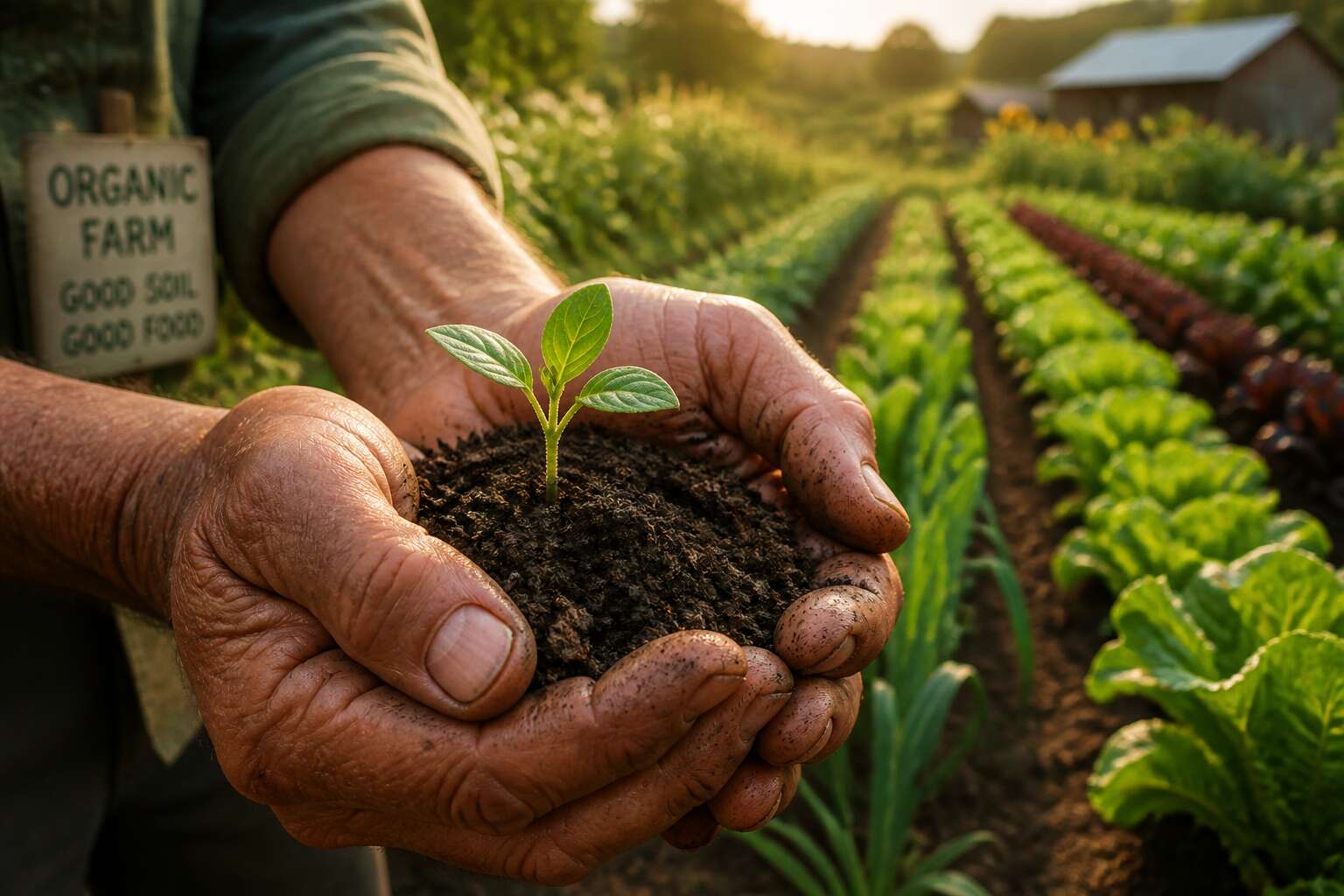
The four principles of organic farming, health, ecology, fairness, and care, are not abstract ideals. They are operational directives. Health begins with the ground beneath our feet. Soil is not inert dirt. It is a teeming matrix of fungi, bacteria, and microarthropods that recycle nutrients and suppress disease. When I hold a handful of healthy soil, I am holding a functioning ecosystem.
Fairness extends beyond the market. It means fair treatment of livestock, fair wages for farmworkers, and fair relationships with the land. Care is the forward-looking principle that asks how a farming practice will affect the seventh generation.
In South Africa, where soil degradation threatens food security, these principles carry immediate weight. An organic farming essay 1000 words long could examine how care translates into water conservation and rotational grazing. Every field is an archive of the choices a farmer has made.
Environmental Sustainability and Organic Practices
Biodiversity Enhancement
On a farm in the Free State, I once watched a row of blackjack weeds host a parliament of beetles. That sighting captures why environmental sustainability and organic practices are inseparable. In a certified organic system, the farmer’s role shifts from conqueror to custodian. By refusing synthetic insecticides, the farmer allows a food web to reestablish itself. An organic farming essay 1000 words could not cover this fully.
Biodiversity enhancement relies on specific mechanisms.
- Habitat architecture uses field margins planted with indigenous grasses and wildflowers to create shelter.
- Resource continuity emerges when rotating crops ensure nectar, pollen, and prey remain available year-round.
- Chemical restraint preserves insect populations by avoiding systemic pesticides.
South Africa’s fynbos and grassland biomes respond to these methods. When a farm nurtures its own pollinators, it no longer relies on imported solutions. The landscape hums with a fertility no fertiliser factory can replicate!
Water Conservation Techniques
In the Karoo, water is a currency more valuable than gold. Organic systems treat every drop as a living asset. Mulching with compost and crop residues slows evaporation, while cover crops like oats and vetch anchor moisture in the root zone. I have seen farms where simple swales redirect rainfall into the soil instead of letting it wash away.
These techniques form a layered defence:
- Drip irrigation delivers water straight to the roots, eliminating waste.
- Polyculture planting shades the ground, reducing the sun’s thirst.
- Rainwater harvesting from sheds and packhouses stores winter storms for summer use.
This is not a luxury for wet regions. It is the essence of an organic farming essay 1000 words, where sustainability and survival share the same tap.
Carbon Sequestration Potential
Carbon sequestration is often treated as an abstract climate solution, but in South African soils it is a measurable opportunity. Organic practices build soil organic matter through compost, rotational grazing, and perennial cover. These methods store atmospheric carbon in the root zone, where it improves fertility and water retention simultaneously.
Research from the Western Cape shows that organically managed vineyards can sequester between 0.5 and 1.2 tons of carbon per hectare annually. The mechanism is simple: plants pull carbon dioxide from the air, and soil biology locks it into stable aggregates. When you read an organic farming essay 1000 words, the carbon story often gets buried under certification details. But the measurable gains deserve attention.
- Compost application increases microbial biomass, which acts as a carbon sink.
- Cover crops extend photosynthesis periods, capturing carbon year round.
- Reduced tillage protects existing soil carbon from oxidation.
The potential is not theoretical. Across the Karoo and the Free State, farmers are measuring darker soils after just three seasons of organic transition. Carbon is the quiet yield no one invoices, but every farmer banks.
Reduction of Chemical Runoff
Stand at the river gauge after a March storm and you will see the difference. Conventional vineyards shed nitrogen and synthetic fungicides into the Berg River. Organic blocks release far less. Compost and mulch build a porous structure that holds nutrients in the root zone, keeping them from washing toward estuarine systems.
Research from Stellenbosch University shows organic vineyard management reduces nitrate leaching by up to 40 percent. Frogs, mayflies, and fish respond quickly when agrochemical loads drop. An organic farming essay 1000 words long might treat runoff as a footnote, but in South Africa it is a water security matter.
The compounds that vanish with organic certification include:
- Synthetic nitrogen, which converts to nitrate and moves easily through sandy soils.
- Copper-based fungicides, which persist in sediment.
- Hormonal herbicides, which disrupt aquatic plant communities.
Eliminating these at the source is cheaper than filtering them from drinking water.
Pest Management without Synthetic Pesticides
Walk through an organic vineyard in the Cape and you will see something: insects doing their job. Aphids attract ladybirds. Caterpillars invite parasitic wasps. Growers monitor thresholds instead of spraying on a calendar schedule.
This is the essence of pest management without synthetic pesticides. It relies on habitat manipulation, beneficial insect releases, and resistant rootstocks. Pests rarely reach economic damage levels.
Some critics expect organic blocks to fail under pest pressure. A 2023 trial from the Western Cape showed organic vineyards supported 60 percent more beneficial arthropods than conventional blocks.
What does this mean for an organic farming essay 1000 words? Pest control is ecology, not chemistry.
Practical tactics include:
- Pheromone disruption for codling moth
- Neem oil applications for sucking pests
- Kaolin clay sprays for leafhoppers
- Trap crops to lure pests away from vines
These methods do not sterilise the system. They manage it. That distinction matters for environmental sustainability.
Health and Nutritional Impacts of Organic Produce
Nutritional Content Comparisons
People who seek an organic farming essay 1000 words usually want a clear verdict on nutrition. The evidence is more layered. Organic crops often show higher concentrations of antioxidants and polyphenols, because the plants produce these compounds as a defense against pests when synthetic pesticides are absent.
I find the mineral comparisons telling. Several meta analyses found that organic spinach, carrots, and lettuce hold more magnesium and iron than conventional versions. The gaps are not uniform, and soil health mediates the outcome.
- Higher antioxidant levels in organic berries and leafy greens
- Lower cadmium levels in organic grains
- Increased phenolic content in organic tomatoes
These nutritional differences are real but modest. Organic spinach may offer more iron, yet the margin narrows once cooking and storage are factored in. The honest comparison leaves room for personal choice.
Reduced Pesticide Residue Exposure
A single conventional apple can carry residues from more than a dozen synthetic compounds. For South African families, that exposure accumulates meal after meal. Choosing organic produce lowers this intake measurably. Research examining human urine samples found that children eating organic diets showed reduced pesticide metabolites within days.
I find this shift meaningful. Organic farming replaces synthetic pesticides with biological controls, so residues do not linger on skin or leaves. Leafy spinach, soft berries, and thin-skinned peaches absorb the most contaminants. When readers request an organic farming essay 1000 words in length, this section changes shopping habits.
Specific numbers help. One meta-analysis found organic produce has four times fewer pesticide residues than conventional counterparts. Another study showed that switching to a wholly organic diet for one week dropped urinary pesticide levels by 90 percent.
The effect is immediate. The body cleanses itself once exposure stops.
Potential Antioxidant Benefits
Antioxidants neutralize free radicals in the human body, and organic produce often provides higher concentrations of these molecules. Comparative studies of spinach, red grapes, and blueberries show consistent increases in polyphenols and anthocyanins when grown organically.
Plants synthesize these compounds partly as a response to environmental stress. Without synthetic pesticides and quick release fertilizers, organic plants develop stronger natural defenses. A 2022 analysis of 40 crops found that organic samples had up to 35 percent more antioxidant activity.
- Phenolic acids support cardiovascular function
- Flavonoids assist immune regulation
This has practical meaning for South African households. Choosing organic peppers or apples adds small but measurable antioxidant intake to every meal. For anyone writing an organic farming essay 1000 words, I see these nutritional differences as a clear, evidence based section. That is a benefit worth defending!
The Debate on Health Outcomes
The health debate around organic produce splits into two camps. One side cites measurable differences in nutrient density and pesticide residue. The other argues these differences rarely translate into clear clinical outcomes. Both positions carry weight, yet the conversation stalls on a simple problem: human diets are messy.
Researchers struggle to isolate organic food as a single variable. People who buy organic often exercise more, smoke less, and eat more vegetables overall. Those lifestyle factors complicate the data. A 2023 meta-analysis found reduced pesticide metabolites in organic consumers, but no definitive reduction in chronic disease incidence. This is not proof that organic fails. It is proof that nutrition science moves slowly.
For South African families, the practical takeaway is modest. When drafting an organic farming essay 1000 words, the honest position is to present the evidence without overstating it.
Economic Considerations for Farmers and Consumers
Premium Pricing and Market Demand
The premium attached to organic produce often raises eyebrows, yet the demand persists with the stubbornness of a Cape Town queue. For farmers, the calculus involves higher labour costs, meticulous certification fees, and the risk of lower yields during transition periods. Those expenses translate directly to retail prices, which can be 20% to 40% higher than conventional goods.
- Consumers perceive organic purchases as an investment in personal health.
- Eco-conscious buyers support reduced chemical footprints.
- Status signaling plays a quiet but potent role in premium markets.
Consumers treat this price gap as a form of social currency. They buy organic to signal discernment, with nutrition playing a secondary role. Market trends in South Africa show steady growth among urban households, particularly in Gauteng and the Western Cape. This demand creates a niche where farmers can thrive, but only if they manage margins carefully. Any solid organic farming essay 1000 words will note that the economic argument hinges on patience and positioning.
Cost of Transition and Certification
Transitioning a conventional farm to organic status is a financial gut check. For three years, yields often dip while pests and weeds act like they own the place. Farmers face certification fees, annual inspections, and soil tests, plus the labour of meticulous record keeping.
- Conversion period expenses with no premium yet
- Certification body fees and inspection travel costs
- Buffer zone management against neighbouring spray drift
Consumers see the final shelf price, not the years of red ink behind it. Farmers absorb losses before earning a single organic premium. Certification bodies charge according to farm size and turnover, so a smallholding in Stellenbosch pays different rates than a sprawling Free State operation. The paperwork alone sends some farmers back to conventional methods. Not because organic fails, but because the transition period works like a subscription with no free trial. That reality deserves its own chapter in any organic farming essay 1000 words.
Yield Comparisons and Profitability
Yield comparisons between organic and conventional rarely align on paper. A conventional maize field in the North West might outproduce its organic neighbour by 20% in a good season. That figure ignores input costs, soil degradation, and the premium organic grain commands. Organic systems often show lower gross yields but higher net returns per hectare, especially for vegetables and fruit in Western Cape markets.
Consumers see the price at the till. They pay more, yet the premium reflects production realities, not greed. Bulk buying and direct farmer-to-consumer sales shift this balance. Smallholders are outpacing large operations by cutting out intermediaries.
Profit margins hinge on a few levers:
- Lower spend on synthetic inputs
- Premium prices that compound
- Soil health reducing long-term costs
Free State wheat studies show organic net margins matching conventional after three seasons. The narrative that organic means lower profit needs updating. Scale, crop choice, and market access decide. Any organic farming essay 1000 words must grapple with this arithmetic.
Support for Local Economies
Money spent on organic produce tends to stay close to home. A farmer who pays workers for weeding and harvesting, instead of buying herbicide, creates jobs that circulate through nearby towns. That spending multiplies. With fewer intermediaries, farmers capture a larger share of the consumer rand, and consumers build direct relationships with the people who feed them. These transactions carry an economic weight beyond the till. Any organic farming essay 1000 words long must account for localised supply chains.
Consider the farmer in the Langkloof who sells to a Cape Town buying group. The margin supports a farm school, a bakkie repair, a seasonal worker’s wages. Small shifts in spending add up. I have seen entire communities stabilise when residents choose local organic. Supporting local growers means supporting local livelihoods:
- Farmers reinvest in equipment and land
- Workers spend wages at local businesses
- Community food security improves
Consumer Accessibility and Affordability
For the farmer, organic systems demand a different kind of financial literacy. Without synthetic inputs, money flows into labour and soil amendments, yet those costs arrive throughout the season while income arrives at harvest. A grower must plan for that gap. Many Langkloof farmers use staggered planting to spread their harvests, ensuring a steady stream of produce instead of a single glut.
For consumers, affordability depends on distribution. A farmer who sells directly to a buying group avoids packing houses and wholesalers, and those savings transfer to the household. In Cape Town, weekly vegetable baskets from such groups often cost less than supermarket equivalents.
Ways consumers access organic produce without breaking budgets:
– Community buying groups
– Farm gate sales
– Seasonal bulk purchases
These arrangements show that an organic farming essay 1000 words long must trace the full journey of the rand, from the farmer’s pocket to the consumer’s table.
Addressing Challenges and Future Directions
Scaling Organic Farming to Global Demand
Scaling organic production to meet global demand is not a marketing problem. It is a supply chain problem. South African smallholders grapple with certification costs, poor cold storage, and unreliable transport. These are the true bottlenecks.
Future directions hinge on decentralised processing hubs, cooperative logistics, and state-backed transition funds. Without them, export promises stay unfulfilled. The path ahead requires concrete choices:
- Regional packing facilities near farming clusters
- Shared refrigerated trucks for cooperatives
- Simplified certification for smallholder plots
This pragmatic focus matters more than ideology. An organic farming essay 1000 words should examine these operational realities and their practical implications. The next decade will test whether we can scale soil health fairly.
Overcoming Misconceptions about Organic Labels
Many South African shoppers assume an organic label means pesticide-free perfection. That assumption is false, and it corrodes trust in the entire system. Organic certification permits a specific list of natural inputs, not absolute sterility. The deeper problem is that consumers confuse marketing gloss with agronomic reality. A smallholder near Mookgophong might follow organic practices for a decade yet lack the paperwork to prove it. Meanwhile, a well funded brand can splatter a leaf logo across a box with minimal oversight. That mismatch fuels scepticism.
Future progress depends on making labels explain themselves. Clear protocols, verifiable supply chains, and straightforward public information will do more than attractive packaging ever could.
Consider what needs to change:
- Transparent sourcing details, not vague nature imagery
- Affordable audits for smallholder cooperatives
- Public education about what organic does and does not promise
An organic farming essay 1000 words long cannot ignore these practical gaps. The label only works when the reality behind it is honest, visible, and accessible to everyone along the chain.
Technological Innovations in Organic Agriculture
South African organic farmers have learned that technology is a useful but imperfect partner. A drone buzzing over a spinach field near Stellenbosch can identify nutrient stress before a human eye spots it. That same drone cannot certify a single hectare, alas. The real innovation lies in linking sensors, satellite imagery, and soil data to reduce guesswork and waste.
Precision tools now allow farmers to apply compost tea or biological controls exactly where needed, rather than applying uniformly across an entire field. This matters for an organic farming essay 1000 words long because it shifts the narrative from philosophy to measurable outcomes. Consider what has gained traction:
- Blockchain ledgers for tracking produce from seed to shelf
- AI powered pest prediction models tailored to local climates
- Low cost soil sensors for smallholder cooperatives
These tools do not replace the farmer’s judgment. They amplify it, which is precisely what organic agriculture needs in a country where water is scarce and margins are thin.
Policy Support and Subsidies
South African organic farmers are navigating a policy landscape that lags far behind their practices. Without targeted subsidies, the conversion period remains financially punishing, often pushing smallholders out before their soils recover. A government backed risk fund could cushion crop failures during the first three years, while reduced certification fees would open doors for cooperatives. Equally important are procurement preferences from state institutions, which would create stable demand. What would shift the needle most: 1. Lower certification costs for emerging farmers. 2. Tax rebates on organic inputs like compost and beneficial insects. 3. Grants for water saving infrastructure. These measures are not handouts, but strategic investments in food security. The organic farming essay 1000 words space readily exposes these gaps, yet policy makers have been slow to act. Farmers need fewer seminars and more concrete financial instruments.
Integrating Organic Practices into Conventional Systems
Conventional farmers often observe organic neighbours with curiosity and caution. The first steps toward integration do not demand wholesale conversion. Composting crop residues or planting nitrogen fixing cover crops can improve soil health without disrupting existing yields.
The road ahead requires honest conversations about risk and reward. Farmer to farmer mentorship programs, where organic pioneers share field data with conventional counterparts, build trust faster than policy documents ever could.
- Start with one field as a trial plot
- Compare input costs and yields across three seasons
- Invite local agronomists to verify results
This practical approach ensures the organic farming essay 1000 words narrative shifts from ideology to measurable evidence.


0 Comments