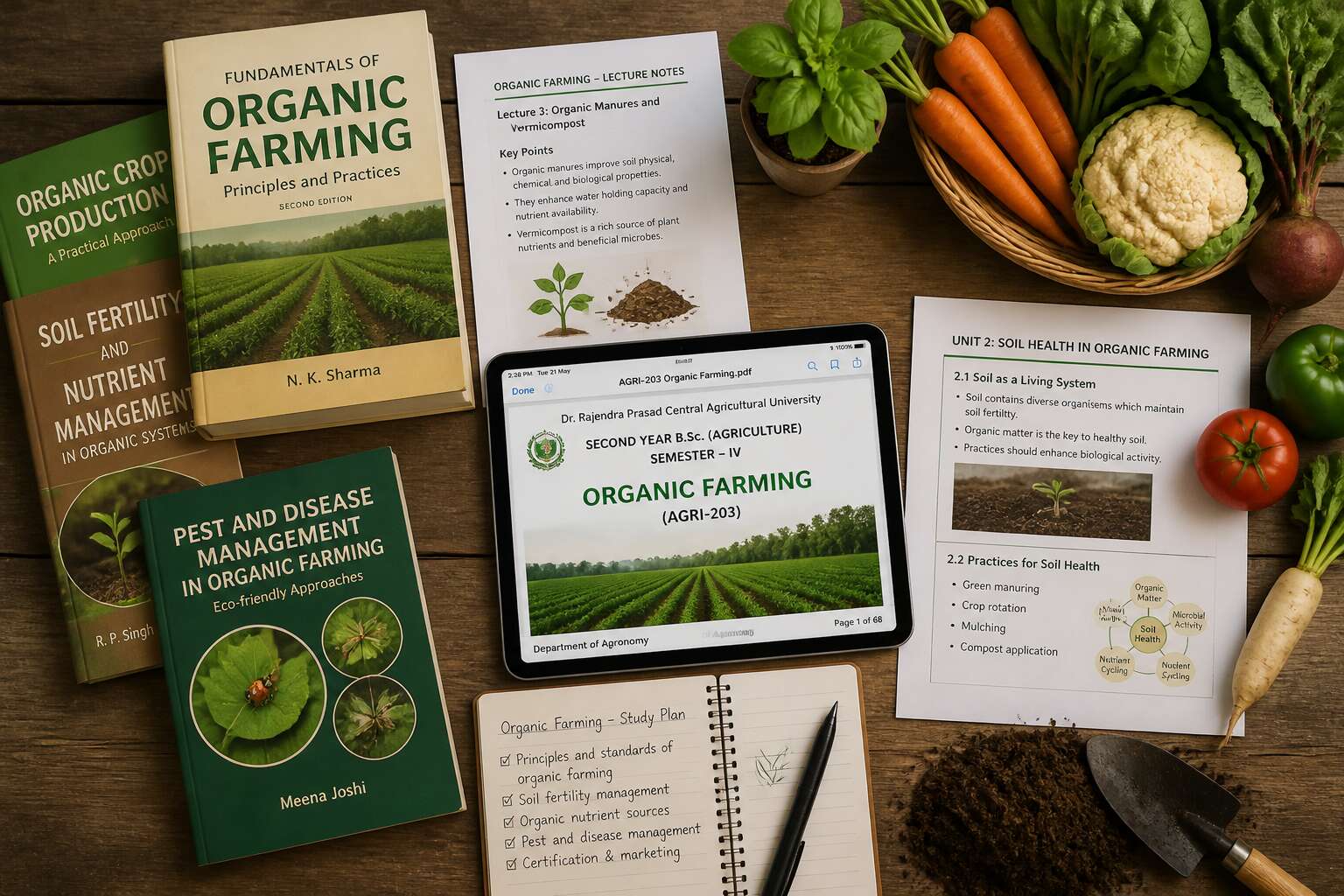
Exploring the Core Concepts of Organic Agriculture
Defining Organic Farming Principles for Advanced Learners
Understanding organic agriculture at an advanced level starts with questioning conventional assumptions. The organic farming 2nd year pdf offers a roadmap for this exploration, yet the real learning lies in the principles behind the practices. I have seen students struggle when they treat these principles as rigid rules.
Instead, consider these core ideas for deeper comprehension:
- Closed nutrient loops that minimize external dependence
- Genetic diversity as a buffer against pests and climate shocks
- Integration of livestock to enhance ecological functions
After teaching this material, I realize that advanced learners thrive when they connect each principle to a living system. The organic farming 2nd year pdf becomes a reference point, but the true test is observing a farm’s resilience over time. That is where the beauty of organic agriculture reveals itself!
Soil Health and Nutrient Management Strategies
Every hectare that loses one percent organic matter retains roughly 150 cubic meters less water. That is a measurable risk on a South African smallholding, yet many second year students overlook its economic dimension when planning their own enterprises.
Nutrient management in this system depends on building biological processes. Compost, green manures, and crop rotations release nutrients at rates aligned with plant uptake. The organic farming 2nd year pdf outlines these mechanisms, but observing them in a working field changes how you interpret the text.
Consider these rotation options for a Highveld smallholding:
- Maize followed by cowpea to fix nitrogen
- Oats or rye for winter biomass
- Comfrey or lucerne as perennial nutrient accumulators
Each rotation shifts nutrient pools, microbial activity, and weed pressure. The organic farming 2nd year pdf serves as a guide, but the field gives the clearest results!
Ecological Pest Control and Biodiversity Conservation
On a Western Cape fruit farm, the difference between a sprayed orchard and an ecologically managed one shows up in the soil, the leaves, and the noise. A sprayed orchard is quiet. A diverse farm hums with predatory arthropods, parasitoid wasps, and birds. These are the real workers in ecological pest control.
The organic farming 2nd year pdf covers the theory of habitat manipulation and floral strips. The field shows what happens when you apply it. Planting indigenous flowering species along crop edges draws natural enemies. They reduce aphid and borer pressure without synthetic inputs.
Biodiversity conservation is the pest management system, not a separate concern. The organic farming 2nd year pdf lists the mechanisms. The working farm demonstrates them.
Consider what a student can measure:
– Count aphid colonies on sprayed versus unsprayed rows
– Trap parasitoid wasps near flower strips
– Monitor bird activity along field margins
These observations turn abstract concepts into usable knowledge.
Comparing Conventional and Organic Systems
Every farm is a ledger of choices, written in carbon, water, and time. Conventional systems chase maximum yield per hectare, often at the cost of the unseen economy beneath the soil. Organic systems accept a different arithmetic. The organic farming 2nd year pdf frames this as a systems comparison, not a moral one. It asks students to weigh external inputs against internal resilience.
The differences appear in the records:
– Energy input per unit of produce
– Water retention during dry months
– Long term soil carbon trends
These are the metrics that separate one philosophy from another. On a Western Cape farm, the two systems sit side by side, yet they behave like different climates. One responds to the bank statement. The other responds to the seasons.
Key Terminology and Standards in Organic Certification
Certification turns philosophical commitments into enforceable procedure. The organic farming 2nd year pdf dedicates space to the terminology governing this translation. Farmers cannot simply call produce organic. The word carries legal weight under the Agricultural Product Standards Act.
The lexicon forms a barrier to entry. Standard terms include:
- Inputs: substances applied to crops, from approved lists
- Buffer zones: distances separating organic fields from spray drift
- Conversion period: the waiting phase, often three years
- Traceability: the documented chain from seed to shelf
- Organic system plan: a binding document of practices
What distinguishes these terms is auditability. Each corresponds to a physical record. I have watched students assume certification is an afterthought. It is not. The organic farming 2nd year pdf stresses that inspectors verify records against actual field conditions. A buffer zone that exists only on paper fails inspection. The certification file is a living document, updated with every input application.
Second Year Curriculum Breakdown and Study Priorities
Major Subjects Covered During the Second Year
Second year pulls you away from the textbook basics and into the rewarding work of running a functioning organic system. In South Africa, where water scarcity shapes every decision, the curriculum places heavy emphasis on climate-adaptive planning. Major subjects covered during the second year include:
- Crop rotation and polyculture design
- Livestock integration for nutrient cycling
- Farm infrastructure and irrigation planning
- Organic enterprise economics and budgeting
Your study priorities should shift accordingly. The organic farming 2nd year pdf provided by most institutions maps directly to these modules, so use it as a weekly reference rather than a once-off read. Practical assessments now require you to defend your choices, which means understanding the reasoning behind each farming decision.
Understanding Crop Rotation and Polyculture Models
The second year breakdown pulls you away from theory and into applied decision making. You move from learning what organic farming is to defending the choices you make in the field. The organic farming 2nd year pdf mirrors this shift, structuring each unit around practical scenarios that demand your reasoning.
Crop rotation and polyculture models form the backbone of this semester. You study how sequences of species affect soil fertility, weed pressure, and water retention. In South Africa, the curriculum pushes you to design rotations that survive erratic rainfall.
- Pair nitrogen fixers with heavy feeders
- Layer ground covers beneath taller crops
- Plan relay planting for the dry season
Understanding these models means studying the interactions themselves, beyond a simple list of crops. The organic farming 2nd year pdf provides the detailed frameworks you work through week by week, and it stays relevant long after the semester ends.
Livestock Integration in Organic Farming Systems
Livestock integration arrives as the second year moves beyond pure crop management. You learn to see animals as partners in the nutrient cycle, not separate enterprises. The organic farming 2nd year pdf walks you through stocking rates, rotational grazing, and the timing of manure application, all calibrated for South African conditions.
Study priorities centre on the relationships between animals and the land.
- Managing kraal manure to match crop nitrogen needs
- Grazing patterns that build soil organic matter
- Fodder planning around seasonal rainfall and veld condition
You examine how livestock interventions affect weed pressure, water infiltration, and farm profitability. The organic farming 2nd year pdf presents case studies that require you to balance animal welfare with ecological outcomes, and those decisions define your competency as a young practitioner.
Organic Farm Business Planning and Economics
Second year curriculum breakdown moves beyond the field into the ledger. You study budgeting cycles, seasonal cash flow, and what certification actually costs against market premiums. The organic farming 2nd year pdf presents these modules with South African price data, not generic examples.
Study priorities cluster around financial survival:
– Cost of production per hectare for organic vegetables
– Break-even analysis for pasture-fed livestock
– Sensitivity to drought and input price spikes
You learn to interpret financial statements with the same attention you give soil tests. For smallholders, the curriculum covers co-operative aggregation and group certification economics. The second year teaches that organic farming succeeds or fails on the strength of its business planning.
Seasonal Planning and Yield Optimization
The second year curriculum breaks the calendar into management windows. Seasonal planning shapes every other decision. You map planting dates against regional rainfall patterns, not generic averages. The organic farming 2nd year pdf includes yield optimisation worksheets for crops like cabbage, spinach, and potatoes, framed with South African temperature data.
For livestock, you plan grazing rotations around veld recovery periods. Getting the timing right takes constant attention. Specific priorities emerge:
- Adjusting planting schedules for Western Cape winter rains versus Highveld summer storms
- Matching irrigation schedules to growth stages rather than fixed weekly intervals
- Forecasting yield dips during heatwaves and planning succession plantings
Yield optimisation is the practical output of all that theory. You learn to read the field daily and adjust. The organic farming 2nd year pdf grounds these decisions in real data.
Water Management and Irrigation Techniques
Over 60% of South Africa’s freshwater goes to agriculture, which makes water management the defining skill of a competent organic farmer. The second year curriculum breakdown and study priorities position irrigation as a precision practice rather than a routine chore. The organic farming 2nd year pdf moves learners beyond theory into measured application.
Students study the relationship between soil texture and water retention, then apply that knowledge to real field conditions. The focus stays on crops in active growth phases, when water stress damages yields most severely. In the Western Cape, this means timing winter rains with early plantings. On the Highveld, it means protecting roots from summer storm runoff.
Study priorities for water management include:
- Interpreting tensiometer readings across different soil depths
- Designing drip systems that target root zones directly
- Calculating rainfall capture from catchment surfaces
- Adjusting irrigation frequency during heatwave events
Each practice requires daily observation. The organic farming 2nd year pdf provides logging sheets and reference tables for these calculations, keeping the daily decisions grounded in verifiable data!
Practical Guides and Hands-On Training Materials
Designing a Second Year Organic Farming Project
Converting theoretical knowledge into field competence requires deliberate practice. For second year students, the difference hinges on turning classroom concepts into a tangible project. A trial plot, a compost schedule, or a pest scouting log teaches more than a semester of lectures.
When I review curricula, I look for materials that force decision making under real constraints. The strongest guides include templates for record keeping, soil test interpretation, and weekly reflection prompts. Students who engage with these tools build diagnostic instincts.
A practical reference is the organic farming 2nd year pdf distributed by many colleges. For South African students, this organic farming 2nd year pdf contains:
- Project briefs with timelines
- Assessment rubrics for certification
- Data collection sheets
These documents turn abstract objectives into measurable actions. They also give instructors a consistent framework for evaluating progress across different climatic regions, which matters greatly in a country as ecologically diverse as South Africa.
Common Farm Visits and Internship Expectations
Nothing humbles a student faster than a stubborn goat or a broken irrigation valve. Farm visits deliver that lesson in real time. The organic farming 2nd year pdf often lists expected competencies for these outings, but the actual assessment happens outside the classroom.
- Farm visit checklists with observation prompts
- Internship logbooks with daily task records
- Safety protocols for handling livestock and tools
Colleges in South Africa typically require a set number of hours on working farms. Students should expect early mornings, repetitive tasks, and supervisors who grade effort over enthusiasm.
Data Collection and Record Keeping for Field Trials
Across South African trial plots, the difference between a useful dataset and a jumble of notes comes down to consistency. I have watched students lose weeks of work because they recorded soil moisture in millimetres one day and percentages the next. That is why the organic farming 2nd year pdf stresses standardisation from the first session. A simple field notebook helps, but structured forms work better for comparisons.
When you set up a trial, decide your variables early. Record weather conditions, plant height, pest damage, and yield weights. Include:
– Date and time of each observation
– Soil temperature at a fixed depth
– Irrigation events and amounts
These details seem dull until a pattern emerges. Then they become the evidence behind your decisions. Without proper records, a successful trial teaches you nothing. With them, you can repeat what worked and skip what failed. That is the whole point of hands-on training.
Post-Harvest Handling and Value Addition
Post-harvest losses on South African organic farms often reach 30%. I watched a student lose an entire cabbage harvest to poor airflow. The organic farming 2nd year pdf tackles this through practical guides on post-harvest handling and value addition. These modules teach specific skills, not abstract principles.
One lesson covers:
– Proper curing of root crops
– Sorting and grading by market standards
– Low-cost storage solutions using recycled materials
Value addition changes how you see surplus. We learned to ferment excess chillies and dry mango slices for long-term sale. These techniques require little capital and transform waste into profit. The training materials include step-by-step visual aids and local case studies. This matters for every farmer facing a glut. You keep the crop alive after harvest, and that is where real money hides.
Using Digital Tools and Apps for Farm Monitoring
The organic farming 2nd year pdf follows you into the field, into the drizzle of a Cape winter. I have watched students hold a phone in one hand and soil in the other, consulting a module on moisture sensors.
Digital tools turn observation into numbers. The training materials guide you through apps that track irrigation schedules, pest scouting routes, and crop development against seasonal norms.
The hands-on modules follow a simple sequence:
- Configuring field boundaries for satellite vegetation indexing
- Linking weather station data to irrigation triggers
- Using photo documentation for pest identification
- Creating shared spreadsheets for team monitoring
Each guide assumes you have never opened a farm app before. The screenshots are local. The examples are South African crops.
That is the quiet strength of the organic farming 2nd year pdf. It places satellite imagery directly into your calloused hands.
Leveraging PDF Study Resources and Online Libraries
Where to Find Reliable PDF Textbooks and Lecture Notes
The second year of organic farming study demands more than field notes. It demands agronomic literature that is both current and credible, yet the cost of textbooks can be prohibitive. South African students increasingly turn to institutional repositories and bibliographic databases housed within university libraries, where lecturers upload their own lecture notes alongside peer reviewed journals. The search for an organic farming 2nd year pdf often begins with these collections.
Several platforms deserve attention for their reliability. The Directory of Open Access Books indexes full length texts with proper licensing. The South African National Library’s digital portal offers regional publications that contextualise organic methods for local climates.
- University repositories such as Stellenbosch and Pretoria host past exam papers and course readers
- ResearchGate and Academia.edu connect students directly with authors who share supplementary materials
Persistence matters here. The right organic farming 2nd year pdf rarely appears on the first search page. It sits within subject specific archives, waiting for a student who knows where to look.
Government Publications and Agricultural Extension Guides
Government publications sit quietly in the background of most organic farming study plans. The Department of Agriculture, Land Reform and Rural Development issues extension guides that translate field research into practical protocols. These files download freely as PDFs, making them a sensible companion to commercial textbooks.
Agricultural extension officers in provinces like Limpopo and the Western Cape distribute seasonal advisories. These guides speak directly to local conditions. The organic farming 2nd year pdf materials found here carry practical weight that academic papers often lack.
A focused search through government archives works well:
- Search the departmental repository using specific crop names
- Combine the word “organic” with your regional pest term
Online libraries, particularly the Agricultural Research Council’s open access platform, add further depth. A student who pairs extension guides with peer reviewed journals builds a balanced reference shelf. That combination defines a solid organic farming 2nd year pdf collection.
Supplementary Reading for Exams and Assignments
We often treat supplementary reading as an optional extra, yet it quietly shapes exam results. The organic farming 2nd year pdf files I found in online repositories gave me a broader perspective than any single textbook could offer. Open access platforms, especially the University of South Africa’s library portal, hold dissertations and research papers that explain the reasons behind farming practices.
When assignments pile up, these resources help you move beyond surface answers. Here is a simple approach that works well:
- Search by your module code to locate syllabus-aligned PDFs.
- Download recent journal articles to cite in your assignments.
- Compare different authors’ views on the same topic to build understanding.
This habit turns exam preparation into an ongoing conversation with researchers rather than a last minute scramble.
Downloading and Organizing Digital Study Materials
Online library portals reward structured researchers. The organic farming 2nd year pdf documents you need are scattered across multiple repositories, often with cryptic filenames. I rely on a basic bibliographic control ritual:
- Create one folder per module and subfolders for topics.
- Rename every downloaded file with the author and publication year.
- Upload a copy to cloud storage for safe access on site visits.
This discipline turns a scattered download history into a functional reference library. When assignment deadlines arrive, you write instead of searching for citations. The organic farming 2nd year pdf you saved in March remains useful in June if you can actually locate it. Online libraries provide the material, but your retrieval system determines whether it contributes to your grades.
Evaluating the Quality of Online Organic Farming Resources
Once your retrieval system works, the next challenge is trusting what you have saved. South African students often conflate a polished PDF layout with academic rigour. When evaluating an organic farming 2nd year pdf, interrogate its provenance. Look for the publisher, the author’s credentials, and whether the content references local conditions rather than generic temperate climate advice. I once downloaded a file from a reputable sounding domain only to discover it was a marketing brochure for synthetic fertilisers. That incident taught me to check the issuing body’s mandate.
The organic farming 2nd year pdf that earns your trust includes several verifiable markers:
- An identifiable author with an institutional email address
- A publication date within the last five years
- References to South African certification standards
A document that discusses maize, rooibos, or citrus farming cycles is immediately more useful than one that only mentions European crop calendars.

0 Comments