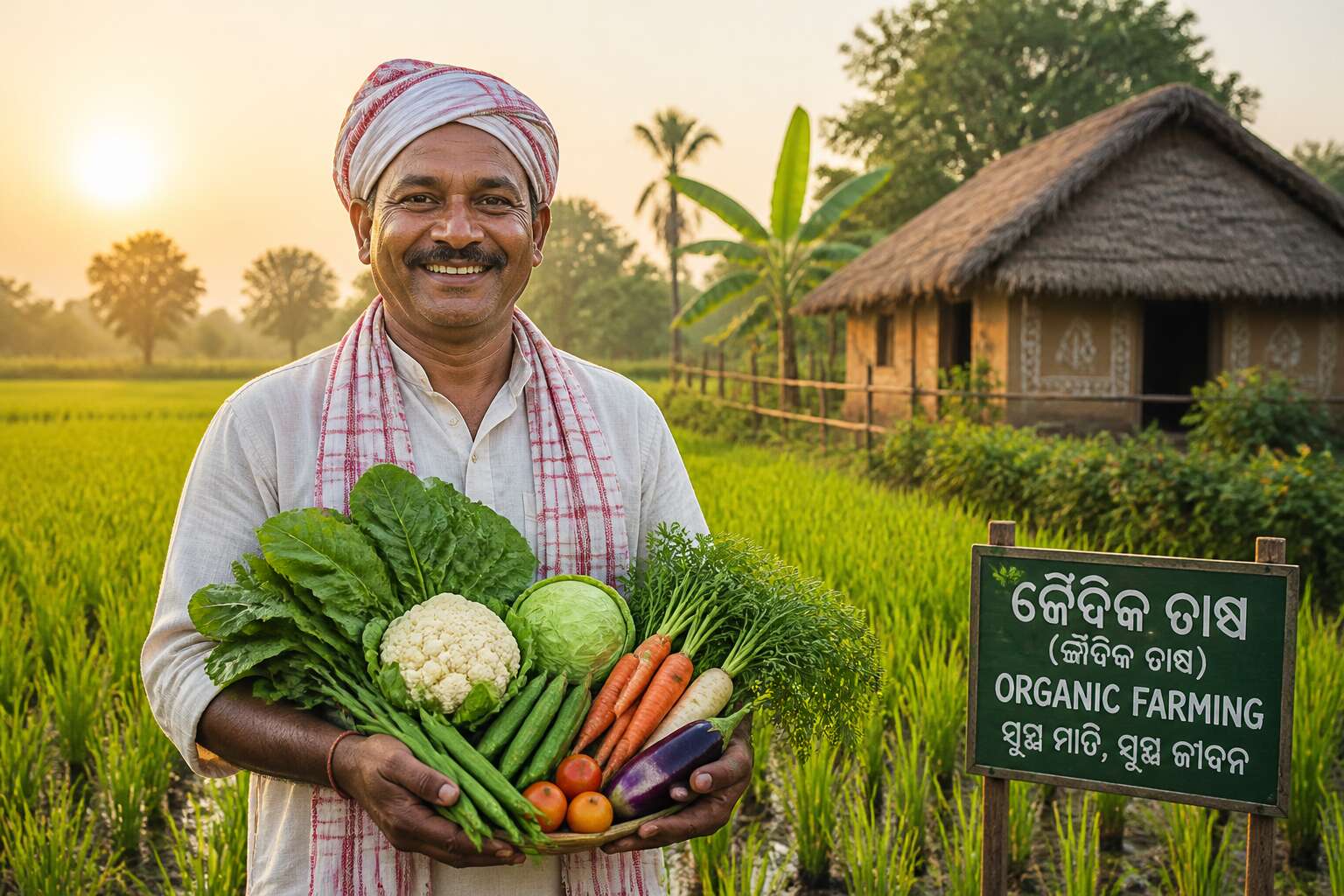
Why Organic Farming Matters for Odisha’s Agriculture
Soil Health Depletion in Conventional Farming
In Odisha, farmers often blame the monsoon for poor yields, but the real culprit sits right beneath their feet. The state’s soil has been quietly depleted by decades of conventional farming. Synthetic inputs deliver quick growth while stripping the ground of its organic carbon, a fact visible in the crumbling texture of many red and lateritic plots.
This is why organic farming odia matters. It rebuilds soil structure through decomposition and natural nutrient cycles, a slow process that yields lasting stability.
Conventional methods degrade soil through familiar habits:
- Mono-cropping drains the same nutrients season after season;
- chemical fertilisers reduce microbial life and increase salinity;
- repeated tilling exposes topsoil to wind and rain erosion.
For Odisha’s smallholders, these losses translate directly into weaker harvests and mounting debt. Organic practices offer a more patient route, one that feeds the soil before it feeds the crop.
Climate Resilience and Monsoon Variability
Monsoon rains in Odisha arrive unpredictably, sometimes flooding, sometimes vanishing. For smallholders, this variability decides between a full granary and an empty kitchen. Organic farming odia creates a buffer that synthetic systems cannot match. Organic matter increases the soil’s water-holding capacity and encourages deep root structures. I have seen this difference firsthand!
Consider the mechanics: organic matter stores excess rainfall and releases moisture slowly during dry spells. This natural regulation reduces crop stress under erratic rainfall. Diverse cropping patterns also spread risk, so a farmer growing millets alongside pulses loses less when one crop fails.
- Lower input costs, since no chemical purchases are needed
- Better moisture retention, cutting irrigation demands during weak monsoons
- Healthier microbial networks supporting plants during prolonged dry periods
Organic farming odia is a tactical response to an uncertain climate, turning variability into manageable risk.
Economic Benefits for Small and Marginal Farmers
For a smallholder in Odisha, the shift to organic farming odia is not an act of nostalgia. It is an economic strategy. Chemical inputs consume as much as a third of a farmer’s working capital. Removing them immediately changes the balance sheet!
Seed saving, compost preparation, and legume intercropping replace purchased fertilisers and pesticides. The farmer retains money that previously left the village economy. Beyond cost reduction, organic produce commands a price premium in urban markets. A farmer selling chemical-free rice or turmeric earns more per quintal, without paying for synthetic inputs.
In practice:
- Lower debt exposure when monsoons fail
- Higher net income per acre over a three year cycle
- Independent seed stocks that reduce annual cash outlay
This capital retention rebuilds household resilience. A farmer with minimal input debt can absorb a bad harvest. The economic margin becomes a survival buffer, not simply a financial metric.
Consumer Demand for Safe and Chemical-Free Food
In Bhubaneswar, the Saturday market turns into a scrum by 8:30 a.m. Wealthy mothers and retiring professors push for leafy greens. They are not seeking bargains. They are avoiding pesticide residue. This preference now functions as social etiquette.
For the grower, the shift is profound. A farmer who practices organic farming odia no longer needs to chase consumers. Instead, consumers ask direct questions about compost and crop rotation. Chemical-free food has flipped the hierarchy of the marketplace.
- Shoppers request the names of individual farms
- Premium prices are paid without complaint
- Suspicion spreads against any sign of synthetic inputs
In Cape Town, food co-ops reflect the same pattern. Whether on the Mahanadi delta or the Western Cape, the grower who produces pure food gains a steady clientele. Demand follows trust, and trust follows transparency.
Key Principles and Practices of Organic Cultivation in Odisha
Use of Indigenous Seeds and Traditional Varieties
Odisha’s traditional seed varieties number in the thousands. These indigenous seeds are central to organic farming odia. Varieties like Kalajeera rice and native millets have adapted to local soils over centuries. They resist pests and tolerate drought without synthetic inputs. Farmers preserve these seeds through careful selection and storage.
The key principles include seed sovereignty and ecological planting. Seeds are dried under the sun and kept in bamboo bins with neem leaves. Community seed banks in Koraput and Keonjhar facilitate exchange. Common practices are:
- Intercropping legumes to fix nitrogen
- Using cow dung slurry for pest control
- Sowing according to local weather patterns
These methods maintain soil fertility and crop diversity. Each seed, passed down through generations, holds the history of Odisha’s farms. I have seen these practices transform small plots into resilient ecosystems.
Natural Compost, Vermicompost, and Green Manure
A single gram of healthy Odisha soil holds billions of microorganisms, a population that synthetic fertilizers dismantle. Natural compost, made from crop residues, kitchen waste, and forest leaf litter, forms the basis of the entire philosophy of organic farming odia. It is a precise mix of carbon and nitrogen, turned and moistened.
Vermicompost takes this process further. Earthworm castings are rich in plant-available enzymes and hormones. The result is a soil conditioner farmers prefer over any bagged product.
In organic farming odia, green manure offers a different renewal. Farmers sow legumes like dhaincha or sunhemp, then plough them back before flowering. This fixes atmospheric nitrogen and adds vital organic bulk.
Common green manure species include:
- Dhaincha (Sesbania aculeata)
- Sunhemp (Crotalaria juncea)
- Cluster bean for coastal sodic soils
These practices feed the microbial consortium that synthetic inputs destroy. I have observed how they give the soil resilience, ensuring every monsoon brings water and renewed life.
Biological Pest Management and Crop Rotation
Odisha’s insect populations respond better to arranged truces than to chemical bombardment. In organic farming odia, biological pest management relies on neem oil sprays, Trichoderma treatments, and the appetite of predatory wasps. A healthy spider population in a paddy field consumes more stem borers than any pesticide ration. Farmers monitor pest thresholds and intervene only when populations cross a practical line.
Crop rotation follows a pragmatic schedule. Paddy grown year after year on the same plot gives stem borers a stable habitat. Farmers alternate paddy with sesame, cowpea, or groundnut to interrupt the pest life cycle while leguminous crops replenish soil nitrogen.
- Paddy, sesame, cowpea
- Maize, groundnut, green gram
- Ragi, pigeon pea, sunflower
These sequences keep pest pressure low and soil structure intact.
Water Conservation and Rainwater Harvesting Techniques
In Odisha’s undulating terrain, water determines the harvest. Organic farming odia relies on capturing the southwest monsoon rather than chasing groundwater that grows saltier each summer. Farm ponds, dug at the lowest point of each field, collect runoff that would otherwise vanish into drains. A simple silt trap keeps the pond functional through the dry months.
Small check dams across seasonal streams slow the water’s escape. Farmers practice ridge and furrow planting, directing every rainfall toward the root zone instead of letting it wash topsoil away. Mulching with rice straw reduces evaporation and holds moisture for weeks after the last shower.
The most effective techniques follow the land’s natural contours:
- Farm ponds with silt traps
- Check dams on seasonal streams
- Ridge and furrow planting
- Rice straw mulching
What strikes me most is how inexpensive and community driven these methods are. The value multiplies when neighbouring villages adopt the same approach. Organic farming odia sustains itself this way when the monsoon turns fickle.
Polyculture and Mixed Cropping Systems
In Odisha’s polyculture fields, no single crop stands alone. Rice shares its flooded terrace with finger millet along the bunds, while groundnut fills the interrows of maize. Farmers pair deep rooted plants with shallow feeders, tall grains with spreading legumes. Each combination works for a reason. Legumes fix nitrogen, broad leaves shade the soil, and scattered aromatics confuse pests.
This mixing creates stability. When one crop fails in an erratic season, others still carry the harvest. Households eat a varied diet, and markets receive multiple products from the same plot. Organic farming odia depends on such layers of interdependence. It rewards farmers who read their land carefully and trust the diversity they have planted.
Common mixed cropping systems in organic farming odia include:
1. Paddy, fish, and dhenkanal gram
2. Maize, groundnut, and pumpkin
3. Millets, horse gram, and cowpea
Common Challenges Faced by Organic Farmers in Odisha
Certification Difficulties and Cost Barriers
Certification stands as the steepest barrier for growers committed to organic farming odia. The journey demands a three year conversion period, meticulous documentation, and multiple inspections. Smallholders in Odisha often find the administrative load crushing, particularly without robust extension services.
The cost structure compounds the difficulty. For a typical two hectare plot, certification expenses can consume nearly a quarter of annual income. Here are the recurring financial pressures:
- Initial application fees and soil tests
- Annual inspection travel and assessor charges
- Laboratory costs for residue analysis
These outlays rarely diminish over time. Group certification offers some relief, yet forming cooperatives requires trust and coordination that many communities lack. As a result, the promise of organic farming odia remains unrealised for numerous farmers who simply cannot afford the label.
Limited Market Access and Price Fluctuations
Even after clearing the certification hurdle, the hardest part for farmers practicing organic farming odia is the marketplace. I have watched growers with flawless produce wait weeks for a buyer while their conventional neighbours sell at roadside depots. Dedicated organic supply chains remain skeletal in Odisha, and the few specialty retailers that exist are clustered in Bhubaneswar. For a farmer in a remote district, reaching those outlets means transport costs that erase the premium.
The absence of local organic mandis creates specific barriers:
- Limited cold storage for perishable produce
- Reliance on middlemen who blend organic and conventional lots
- No contractual floor for organic prices
Price fluctuations then compound this isolation. When a bumper crop lands, the organic tag offers no protection. Farmers often accept conventional rates just to recover their investment, which undermines the premise of organic farming odia. That reality is a tragedy for the entire movement!
Lack of Technical Knowledge and Extension Support
Ask any organic farmer in Odisha about the hardest crop to grow, and they will not say paddy or millet. They will say guidance. Extension officers rarely understand the biological nuances of organic farming odia. Most were trained for chemical agriculture. They know NPK ratios, but not how to read leaf damage for pest pressure.
This vacuum leaves farmers to experiment alone. I watched a farmer lose an entire okra plot because no one told him the right neem oil concentration for aphids. University research never reaches remote blocks. Without extension support, organic farming odia becomes a series of expensive guesses.
- No organic pest calendars for local crops
- No training on soil biology testing
- No guidance for transition periods
When a farmer fails, they blame the method, not the missing support system.
Transition Period Yield Decline
In the first two years of conversion, many Odisha farmers watch their yields fall by 20 to 30 percent. This transition period yield decline tests patience, especially for families living harvest to harvest.
The soil takes time to rebuild its microbial web. Chemical residues linger while beneficial insects return slowly. A farmer who harvested 20 quintals of paddy may suddenly see 14. The drop signals a natural recalibration, not crop failure.
During this window, farmers face:
- Reduced market prices for uncertified organic produce
- Higher labour costs for manual weeding and composting
- Debt pressure from delayed returns
Many abandon organic farming odia before the soil reaches its full potential.
Inadequate Supply Chain Infrastructure
In Keonjhar, a truckload of organic okra bounces down a rutted road. The nearest collection centre is 40 kilometres away. By the time produce reaches Bhubaneswar, a third has wilted. This is organic farming odia in a state where cold storage remains a rumour.
The supply chain is a patchwork of gaps. Haulers mix certified crops with conventional ones, breaking traceability. Rural roads vanish under monsoon rains. Aggregation points are scarce, forcing smallholders to sell at lower prices. Key infrastructure lacks:
- No cold storage in most blocks
- No climate controlled trucks
- No grading sheds near farms
These gaps erode profits. Without infrastructure, the premium for organic produce never reaches the farmer.
Pest and Weed Management Without Synthetic Inputs
Pests and weeds do not surrender when synthetic inputs vanish. For organic farming odia, this is a daily battle. In Odisha’s humid fields, the brown plant hopper multiplies after every downpour, so farmers scout by hand and pluck egg masses from rice leaves. Weed pressure peaks during the monsoon when labour is scarce and wages rise. One farmer described pulling kanta khada for three weeks straight, only to see new shoots emerge overnight.
Without herbicides, the weeding calendar controls everything. A single missed week means the crop suffocates. Neem oil and panchagavya offer limited relief, but they need repeated application. Biological predators arrive late, if they arrive at all. Many smallholders end up shifting to less pest prone pulses, which shrinks their organic plot.
Government Policies and Support Programs for Organic Farming in Odisha
Odisha Organic Agriculture Policy and Mission
Government support for organic farming odia has shifted from lip service to actual budgets. The Odisha Organic Agriculture Policy and Mission created a structured pathway for farmers who want to abandon synthetic inputs. One striking figure: the state earmarked substantial funds for certification subsidies and market linkage. That matters because certification costs previously crushed smallholders.
The policy pushes a cluster approach. Villages are grouped into organic zones, which simplifies training and input supply. It also tackles a hidden problem: the transition period. Farmers lose income for two or three years, so the mission provides a financial bridge.
– Direct benefit transfers for farmers during conversion
– Support for bio-input production units at the block level
– Dedicated procurement channels for certified produce
These measures do not promise miracles. They do create a workable framework for scaling organic farming odia beyond scattered plots. The real test is whether district officers can execute with the same energy the policy documents show.
Paramparagat Krishi Vikas Yojana (PKVY) Implementation
Paramparagat Krishi Vikas Yojana, or PKVY, works through farmer clusters in Odisha. Each cluster gets Rs 20,000 per hectare over three years, paid directly into bank accounts. This money covers seeds, bio-inputs, and certification fees. What stands out is the requirement for a local bio-input unit. Farmers produce their own compost and pest repellents, cutting costs and building self-reliance.
- Cluster size fixed at 50 hectares
- Field officers validate every input record
- Training sessions run at the village level
The scheme also funds soil testing before conversion. That baseline data helps farmers track changes over time. For organic farming odia, PKVY offers a structured path from conventional plots to certified land. The real challenge is keeping district staff accountable, but the framework itself is sound.
State Subsidies for Organic Inputs and Certification
Odisha’s state government quietly reimburses certification costs for farmers who go organic. The financial burden of that official stamp often deters smallholders. State subsidies ease that strain. Farmers can claim support for inspection fees, testing charges, and certification paperwork. Input subsidies follow a similar logic. The government offers direct assistance for neem oil, trichoderma, and other biological inputs.
One might expect bureaucratic friction, but the application process is surprisingly straightforward. Local agriculture offices handle submissions; verification happens at the block level. The money lands in bank accounts. For those practicing organic farming odia, these subsidies narrow the gap between intention and certified reality.
Subsidized components include:
- Certification and inspection fees
- Soil and residue testing charges
- Bio-fertilizers and biopesticides
The state maintains a dedicated fund for group certification, making the process affordable for farmer producer organizations. Organic farming odia communities have used this support to convert entire villages.
Farmer Producer Organizations and Collective Marketing
Nearly 200,000 hectares in Odisha now sit under farmer producer organizations transitioning to certified organic land. For practitioners of organic farming odia, the collective model is transforming the economics of chemical-free cultivation.
Individual smallholders rarely command market attention. FPOs change that equation. When farmers organize, they aggregate produce, share storage infrastructure, and negotiate from collective strength. The Odisha government’s policy framework supports these groups through:
Common facility centers for sorting and packing
Cluster-level cold storage access
Direct buyer and processor linkages
Organic farming odia communities gain more than better prices. Risk spreads across members. Knowledge circulates between farms. Farmers who once avoided certification because of paperwork now find their FPO managing the process entirely.
I have watched this model reshape village supply chains. Policy intent becomes real when the organizational unit shifts from individual to collective. That is where Odisha’s organic transition gains traction.
Research and Training Initiatives by Agricultural Universities
Odisha’s agricultural universities now treat organic farming odia as a practical subject. Research stations test local inputs with the same rigor they once applied to chemical packages!
Training programs place farmers in demonstration plots. One extension officer told me the real learning happens when soil responds faster than policy documents.
- Field trials comparing traditional and modern organic methods
- Workshops on biological pest control for village trainers
- Documentation of indigenous seed varieties
Government policies fund these university initiatives. Each district receives a designated training hub. Certification support flows through these centers. For organic farming odia, this reduces guesswork and builds a knowledge base farmers can trust.
Success Stories and Future Opportunities in Odisha’s Organic Movement
Village-Level Organic Clusters and Community Initiatives
Three years ago, Deomali village in Koraput was losing its young farmers to city labor. Today, community managed organic plots feed forty families. What changed? A local women’s collective decided to govern their farmland together. Similar village level organic clusters in Rayagada and Keonjhar now pool their resources, negotiate with buyers, and plan cultivation as a group. These successes matter beyond food production. They rebuild trust and self reliance.
The future of organic farming odia lies in connecting these clusters into larger federations, investing in community storage facilities, and creating mentorship programs where successful villages guide newcomers. What started as isolated efforts can become a statewide network of resilient rural economies!
Organic Exports and Premium Pricing
When a cooperative in Kandhamal shipped its first container of organic turmeric to Europe, the price per kilogram tripled against local market rates. That single sale reshaped how neighboring villages viewed organic farming odia. Export buyers now seek Odisha’s indigenous varieties, such as black rice and ginger, for distinct flavor and traceable origins.
Premium pricing requires consistent quality, reliable volume, and packaging that meets international standards. Some producer groups achieved this through direct buyer ties. Others used state sponsored trade fairs to connect with overseas importers.
- Organic turmeric from Koraput earns a 40 percent premium in Europe
- Certified organic black rice from Bargarh sells at double the domestic wholesale price
- Ginger cooperatives in Kandhamal supply health food chains in Germany
The opportunity ahead involves scaling these isolated wins into a recognizable regional brand. Organic farming odia can position itself as a premium origin, similar to basmati from India or rooibos from South Africa, but only with coordinated export strategies and shared infrastructure.
Role of Women Self-Help Groups in Organic Agriculture
When a women’s self-help group in Ganjam began converting a single acre to organic paddy, they did not expect to become a model for three neighboring villages. Their success came from pooling resources and sharing weekly observations of crop health. Today, that group manages a certified organic plot and trains new members in seed saving.
Future opportunities lie in expanding these SHG networks into district level federations. Such structures can aggregate produce, negotiate with buyers, and access state schemes more efficiently. Women already handle sorting, grading, and record keeping, which positions them to lead quality assurance for organic farming odia operations.
- Seeds banks run by SHGs preserve traditional varieties
- Shared processing units reduce post harvest losses
- Collective procurement of bio inputs cuts costs
The next step is linking women-led organic clusters to institutional buyers, including schools and hospitals. With consistent policy support, these groups can transform rural livelihoods.
Digital Platforms and Direct-to-Consumer Models
In Puri district, a group of certified organic farmers now sells their vegetables through a WhatsApp-based ordering system. Customers in Bhubaneswar send requests before dawn, and the produce arrives by noon. This direct-to-consumer channel has increased their income by thirty percent. I have watched farmers who once accepted wholesale rates now set their own prices. They track soil health and harvest schedules using a shared spreadsheet, a simple digital shift that cuts uncertainty.
Future opportunities lie in expanding these digital networks into full-fledged e-commerce platforms. Farmers can pool their yields, offer subscription boxes, and share their stories directly with buyers. For organic farming odia, this means less dependence on volatile wholesale markets. The next step is integrating payment gateways and cold chain logistics into these platforms, making farm-to-table a reliable daily reality.
Integrating Organic Farming with Agro-Tourism
At a family farm in Dhenkanal, the night before a full moon draws strangers in. They come for the rice fields, the goats, and the quiet. Last harvest, the Sanghamitra family earned more from hosting two dozen tourists than from selling their entire mango crop. That extra income paid for a solar-powered irrigation pump. For organic farming odia, agro-tourism offers a direct income stream beyond the market.
The future lies in linking these farm stays to regional organic clusters. Travellers want to see where their food grows. A few farms now offer weekend programs where guests prepare compost and taste heirloom varieties. This is where organic farming odia can grow. With state support for rural homestays, Odisha could create a tourism circuit that sustains both soil and community.
Scaling Up Organic Practices Through Youth Engagement
In Odisha, the organic movement is finding new energy in its youth. Take the example of a farmer producer company in Koraput, run by people under thirty. They manage 200 acres of certified organic farmland using traditional seeds and modern soil testing. Their success led to a partnership with a state university.
Scaling up organic farming odia requires more such bridges. Young farmers bring digital skills and a willingness to experiment. Fellowships and agri-preneurship programs are emerging. A few districts now run youth-led extension camps where farmers learn composting and pest control. These camps have trained over 1,000 farmers. The next step is to link these young leaders with policy bodies. Their presence in organic governance could reshape how subsidies reach the ground.
The focus must shift from individual farm success to ecosystem building. With proper mentorship, this generation can turn organic farming odia into a statewide movement.

0 Comments