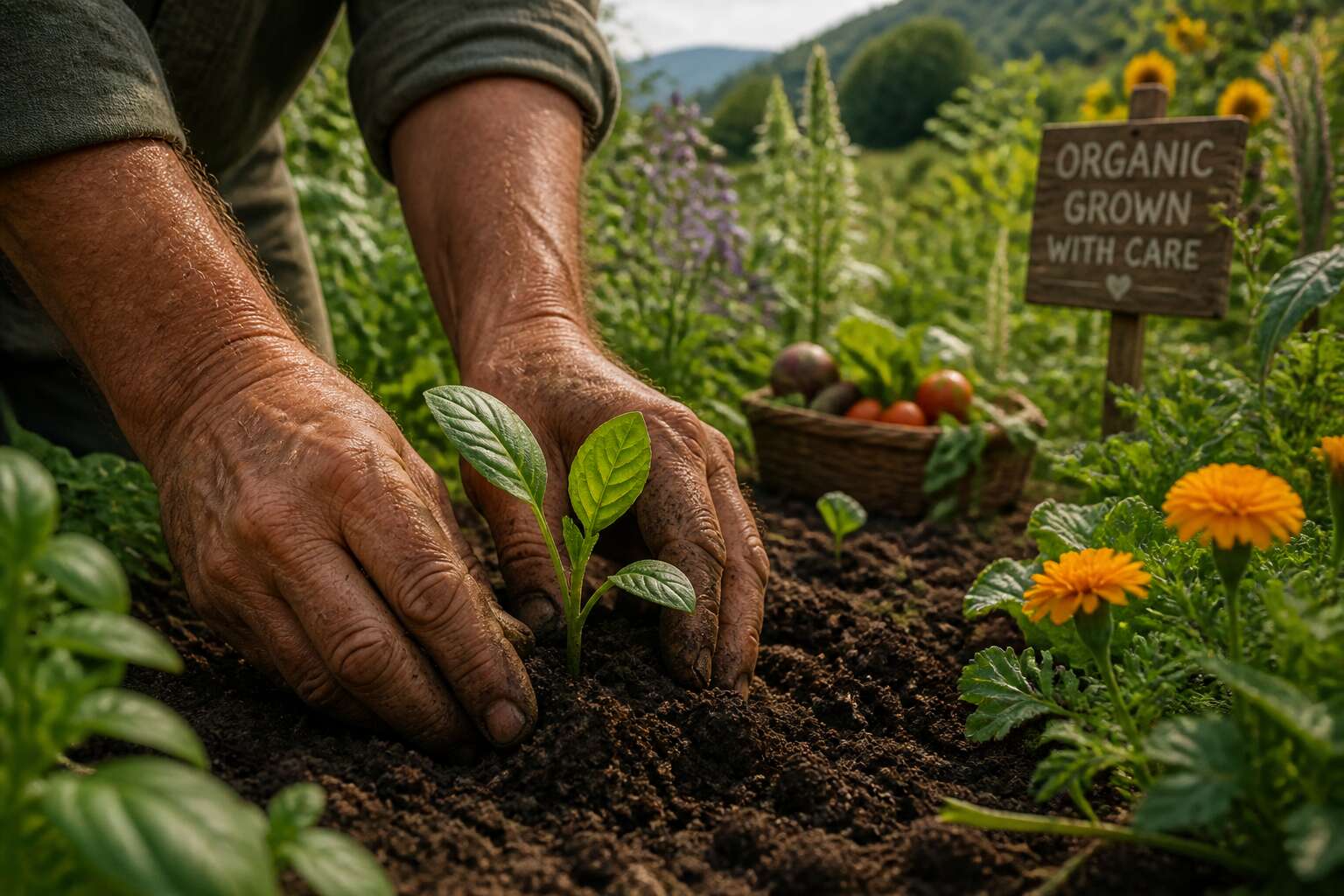
Understanding Organic Farming Fundamentals
Defining Organic Agriculture in Modern Context
I have walked through Free State fields where the soil is so depleted that even weeds struggle. When a farmer there tells me she farms organically, she rarely means a certification sticker. She means the soil responds to her care. Modern organic agriculture, as defined by IFOAM, is a production system that sustains the health of soils, ecosystems and people. It relies on ecological processes.
Understanding what are organic farming methods starts with this shift in mindset. The methods are diverse: crop rotation, composting, biological pest control, green manures. Each one mimics natural cycles. In South Africa, where water is scarce and land is degraded, these techniques carry particular value!
- Composting builds soil carbon and reduces reliance on chemical fertilisers
- Cover cropping prevents erosion and fixes nitrogen
- Predator insects manage pests without toxic residues
This is not nostalgia for old ways. For anyone asking what are organic farming methods, this is the foundation.
Core Principles Behind Organic Production
Organic production is governed by four interlocking principles: health, ecology, fairness, and care. These are not abstract ideals. They shape every decision on a regenerative farm. Health means nurturing soil organisms, not just feeding plants. Ecology demands that farms function like ecosystems, with waste from one component feeding another. Here are the practical anchors:
- Biological nitrogen fixation from leguminous plants
- Rotational grazing that mimics wild herbivore patterns
- On-farm seed saving to preserve adaptive traits
Fairness extends to farm workers and local communities. Care requires a farmer to act cautiously, never risking long-term fertility for short-term gain. This framework guides what are organic farming methods, separating certification from genuine practice.
Historical Development and Global Adoption
Organic farming fundamentals stretch back further than most assume. The term itself only gained traction in the 1940s, but the underlying practices are ancient. Roman agricultural texts describe crop rotation and compost management in detail. The modern organic movement emerged as a direct response to the synthetic fertilizers and pesticides introduced after World War II.
In South Africa, I have watched organic agriculture grow steadily over the past two decades. Smallholder farmers have adopted these methods alongside commercial operations. Adoption patterns vary by region:
- Western Cape leads in certified organic vineyards and fruit orchards
- KwaZulu-Natal shows strong smallholder participation in community-supported agriculture
- The Karoo region demonstrates rising interest in regenerative livestock practices
Understanding what are organic farming methods requires examining this history. The systems refined over centuries now anchor contemporary certification standards worldwide!
Core Soil Health Practices
Crop Rotation and Polyculture Diversity
Healthy soil is the basis of every organic farm. To understand what are organic farming methods, one must look at how farmers manage the ground. Crop rotation breaks pest cycles and replenishes nutrients through alternating root structures. Polyculture diversity reduces disease pressure and improves soil structure.
Consider a three season plan!
- Legumes fix nitrogen for the next grain crop.
- Deep taproots pull minerals from lower soil layers.
- Flowering plants attract beneficial insects.
These practices maintain productivity without synthetic inputs. I have watched farms transform on such plans. Organic farming depends on deliberate, consistent care for the land.
Composting and Application of Green Manures
Composting transforms farm waste into a living bank of nutrients. In the Karoo’s thin soils, a well-made heap can hold moisture for weeks. I have seen compost applied at five tons per hectare change the structure of cracked earth within a single dry season. This is a core answer to what are organic farming methods. The process requires balancing carbon-rich browns with nitrogen-rich greens, turning the pile until it heats and steams.
- Old maize stalks and leaves create air pockets.
- Fresh manure and kitchen scraps feed microbial activity.
- Rock dust adds trace minerals.
Green manures work from within, planted in autumn and slashed before seeding. A stand of grazing vetch or lupins sheaths the soil against the summer sun, then releases nitrogen as it decomposes. These cover crops also suppress weeds without a single chemical application. Every farmer who understands what are organic farming methods knows this sequence: compost feeds the soil organism, green manure feeds the next crop, and the soil feeds us.
Cover Cropping and Mulching Strategies
In the Karoo, the soil remembers every drought. Cover cropping is the shield against that memory. A dense stand of grazing vetch or oats planted before the first frost holds the earth in place. When slashed, it leaves a shroud of organic matter that cools the surface and feeds the organisms below. This is part of what are organic farming methods, a system that works with decay rather than against it.
Mulching strategies follow the same logic. Old straw, pruned branches, and even crushed stone act as a barrier. They slow evaporation and keep the topsoil from blowing away. The ground stays darker, damper, and alive.
Some farmers layer:
- Straw or hay between crop rows
- Composted bark around fruit trees
- Weed-free grass clippings on vegetable beds
Each layer suppresses weeds and returns carbon to the soil.
Reduced Tillage and No-Till Approaches
Ploughing disrupts soil life. When a farmer asks what are organic farming methods, the answer begins with reduced disturbance. Reduced tillage works only the top few centimetres. No-till requires no plough, no disc, no inversion. The soil structure remains intact, holding water and air. In South Africa’s drylands, this is survival. Worms and fungal networks persist. Carbon stays locked in aggregates.
A simple sequence works for most small holdings:
- Kill the previous cover crop by rolling it flat.
- Plant directly through the residue with a seed drill.
- Keep roots in the ground year round.
The first season shows weed pressure, but the second season reveals the shift. Organic matter climbs, and erosion drops.
Managing Soil Fertility with Natural Inputs
The shadow of nutrient deficiency falls hard in South African drylands. What are organic farming methods when the soil is brittle and pale? The answer lies in crushed basalt, seaweed extract, and fish hydrolysate. I have seen a bare patch turn fertile after one patient season!
Selection requires a soil test, not guesswork. Consider these options:
- Rock phosphate for slow phosphorus release
- Dolomite to stabilise pH
- Kelp meal for trace minerals and fungal support
Each input works through the microbial web. Overfeeding disrupts that web. The soil holds its own rhythm; listen, and adjust.
Natural Pest and Weed Management Techniques
Biological Control Using Beneficial Organisms
Pests in organic systems are not enemies to be annihilated. They are, in a sense, poorly behaved guests. Biological control enlists their natural predators. Ladybirds devour aphids with the enthusiasm of a tourist at a bunny chow stand. Parasitic wasps lay eggs inside caterpillars, which sounds grim but works splendidly. This approach reduces the need for synthetic interventions.
To implement this, farmers might consider:
- Releasing predatory mites for thrips control
- Planting nectar-rich borders to attract hoverflies
- Maintaining beetle banks for ground beetles
These tactics form a key part of what are organic farming methods. They rely on ecological relationships rather than chemical sprays. A balanced farm becomes a self-regulating system, where pests never gain the upper hand. It is a quieter, more patient form of agriculture.
Botanical Pesticides and Natural Repellents
Botanical pesticides offer a different philosophy. They derive from plants that have spent millennia evolving chemical defenses. Pyrethrins from chrysanthemums, neem oil from the neem tree, rotenone from certain roots. These substances degrade quickly in sunlight, leaving no persistent residue.
Understanding what are organic farming methods requires accepting this impermanence. A botanical spray kills today’s aphids, but it does not protect tomorrow’s. The farmer must observe, anticipate, and reapply. Some practitioners add:
- Garlic and chili sprays for chewing insects
- Diatomaceous earth for crawling pests
- Companion planting with marigolds and basil
This demands patience. The organic farmer reads pest populations as signals of imbalance, not emergencies. The spray is a response, not a solution. It works alongside observation, not in place of it.
Cultural Weed Prevention Methods
Cultural weed prevention relies on timing and crop competition. The stale seedbed technique is a practical example. In my experience, it demands patience. A farmer prepares the soil, allows weed seeds to sprout, then destroys those seedlings before planting. This removes a generation of weeds without a single herbicide application.
Planting density matters. Dense crops shade the soil, suppressing weed germination. Clean farm equipment prevents weed seeds from spreading between fields. Understanding what are organic farming methods includes recognizing these preventive choices.
Cultural methods to consider:
- Adjusting planting dates to miss peak weed emergence
- Selecting crop varieties that outcompete weeds
- Scheduling irrigation to keep the upper soil layer dry
Weeds thrive on disturbance and open ground. The organic farmer minimizes both.
Integrated Pest Management Systems
South African farmers lose up to 40% of their yields to pests each season. That figure drives the shift toward integrated pest management systems. These systems do not rely on a single tactic. Instead, they combine monitoring, habitat manipulation, and targeted interventions.
In my experience, IPM treats the farm as a living network. You observe pest populations before acting. You tolerate harmless insects. You intervene only when damage crosses a threshold. This approach sits at the core of what are organic farming methods.
- Scouting fields twice weekly to track pest numbers
- Releasing predatory insects like ladybirds for aphid control
- Using pheromone traps to disrupt mating cycles
The result is a resilient system! Pests seldom build resistance because no single pressure dominates. Natural control agents remain active. The farm works with ecology, not against it.
Organic Livestock and Animal Husbandry
Pasture-Based Feeding and Grazing Plans
The true measure of organic farming methods extends beyond the fields into the daily rhythm of the herd. I have seen farmers in the Karoo rotate cattle across paddocks, allowing grass to recover before the next bite. This approach, called managed intensive grazing, builds soil carbon while keeping animals healthy. A well designed grazing plan requires careful observation along with basic infrastructure.
Consider these elements of a pasture based system:
- Stock density matched to forage growth rates
- Rest periods that vary with rainfall and season
- Water points that encourage even distribution of manure
Each farm in South Africa must adapt these principles to its own biome. What are organic farming methods if not a local response to land and climate? The animals become active participants in the soil’s renewal, not mere producers.
Animal Welfare and Humane Housing Standards
Organic certification demands more than a ban on synthetic inputs. It asks how the animal lives within its environment. Humane housing standards require space for natural movement, protection from harsh Karoo winters or Highveld thunderstorms, and clean bedding that does not mask underlying health problems.
What are organic farming methods without a commitment to the creature’s dignity? In South Africa, organic livestock management often means free-range systems with mobile shelters that follow the herd. These structures allow manure to drop where it belongs, disrupting the parasite lifecycle that affects stationary pens.
Consider the thresholds most certifiers examine:
- Indoor space allowances that exceed conventional industry norms
- Access to outdoor areas during all growth stages
- Zero reliance on routine antibiotics or growth promoters
These standards change how the farmer observes and responds to the herd. The animal’s behaviour reveals whether the system works.
Preventive Health Care Without Antibiotics
Preventive health care in organic livestock begins with observation. The farmer reads the herd’s behaviour, noticing shifts in appetite or posture before clinical symptoms appear. This daily attention replaces the reactive antibiotic approach.
What are organic farming methods without this vigilance? They become management systems that prioritise prevention. Key practices include:
– Rotational grazing to break parasite cycles
– Nutritional supplementation tailored to seasonal veld conditions
– Selective breeding for hardiness and disease resistance
Herbal remedies and homeopathic treatments serve as supportive tools, not substitutes for sound husbandry. The Karoo’s harsh conditions demand resilience. A well-managed organic herd thrives because its environment supports immunity, not because pharmaceuticals mask problems.
Certification, Standards, and Compliance
Navigating USDA Organic Certification
The USDA Organic seal adorns products worth over $50 billion annually. Behind it lies a regulatory labyrinth. Navigating certification means every input and practice must trace back to an approved National List. For South African growers eyeing export markets, this compliance is both a barrier and a credential.
Certification begins with an application to an accredited agent, followed by a transition period. Inspectors audit fields, storage areas, and ledgers. They check for commingling risks, buffer zones, and prohibited substances. The core phases are:
1. Submit an Organic System Plan
2. Undergo on-site inspection
3. Receive certification decision
4. Maintain annual renewal and residue testing
Throughout this process, the central question remains: what are organic farming methods if not documented ones? The paper trail transforms philosophy into verifiable practice. Standards create a shared language that lets consumers trust a label across continents. Without this regulatory spine, organic claims dissolve into marketing noise.
International Organic Standards and Equivalency
International organic standards rarely align perfectly. Equivalency agreements between certifying bodies allow products to cross borders without redundant audits, yet each market keeps its own residue thresholds and prohibited input lists. For South African exporters, the EU and US frameworks often hold sway.
- Harmonised inspection protocols reduce duplication
- Mutual recognition depends on comparable enforcement
- Trade partners verify traceability at every stage
When a single farm seeks access to multiple markets, compliance becomes a layered exercise. The answer to what are organic farming methods shifts from local practice to global proof. A technique accepted in one jurisdiction may face restriction in another, so documentation must reflect the stricter standard. Equivalency rewards precision. Understanding what are organic farming methods means reading these standards as a record of accepted inputs across borders.
Record Keeping and Inspection Requirements
Certification demands more than good intentions; it demands a paper trail that could make a forensic accountant weep with joy. Every input, every harvest, every sale must be logged with the same care you’d give a bank statement. For South African farms chasing multiple market approvals, this becomes a masterclass in administrative stamina.
Inspections arrive unannounced, and the inspector’s first stop is usually your records, not your fields. They check:
- Seed purchase invoices showing certified organic origin
- Spray and fertiliser application logs with dates and quantities
- Sales receipts linking produce to specific plots
Without this evidence, even perfect farming practices fail review. Understanding what are organic farming methods goes beyond soil and seed; it includes the daily habit of proving your claims. The stricter standard becomes your baseline, because equivalency only rewards those who document every step.
Transitioning Land to Certified Organic Status
The transition to certified organic status tests patience more than technique. Most standards require three full years without prohibited substances before crops earn organic certification. That land is farmed organically but sold conventionally, often at a financial loss.
This period carries weight. Yields may dip while inputs cost more. The process forces a reckoning with what are organic farming methods in practice. Conversion is not a switch but a slow renegotiation between soil and farmer.
Certification bodies track every season during this window. Soil tests establish baseline fertility. Buffer zones must be planted against spray drift. Transition requirements follow a predictable sequence:
- Land history audits covering previous inputs
- Baseline soil and water sampling
- Buffer zone implementation around neighbouring farms
For South African growers exploring what are organic farming methods, the waiting period is not wasted. Start the process early and align with multiple standards simultaneously. Time spent in conversion becomes market access later.
Challenges, Myths, and Economic Realities
Yield Comparisons and Productivity Concerns
One persistent myth claims organic farms inevitably produce far less food. Yield comparisons tell a more complicated story, with organic systems trailing conventional by roughly 10 to 20 percent in normal seasons, yet matching or exceeding them during drought years. Productivity concerns often center on labor and management intensity.
Understanding what are organic farming methods requires confronting these economic realities. Transition costs, certification fees, and higher labor demands create genuine barriers, especially for smallholders in South Africa. Price premiums can offset these burdens, but market access remains uneven.
- Weed pressure peaks during the first three years after conversion.
- Post-harvest losses may rise without synthetic preservatives.
- Soil fertility builds slowly, delaying full yield potential.
The challenges are real, but so are the adaptive strategies. Farmers who embrace what are organic farming methods often see improved soil structure and lower input expenses over time. That’s the tradeoff, and it deserves honest discussion.
Debunking Common Misconceptions About Organic Farming
Organic farming is often painted as old-fashioned, yet the practice is highly technical. A stubborn misconception holds that organic growers simply stop spraying. What are organic farming methods really demands an intricate grasp of ecological interactions, pest dynamics, and soil biology.
The economic picture is equally nuanced. Certification does not guarantee a premium, and market access in South Africa can be erratic. Farmers who build direct relationships with buyers often find stability, while cheap synthetic inputs merely defer environmental costs.
- Myth: Organic farmers never lose crops to pests. Reality: they scout fields daily and intervene strategically.
- Myth: Organic methods ignore modern science. Reality: plant breeding and biocontrol research are central to the system.
Costs, Premiums, and Market Opportunities
Transition costs in South Africa are steep. Certification fees, inspection travel, and three years of reduced output strain smallholders. Yet the premium question is not simple. Some buyers pay 20% above conventional, while others treat organic as a baseline requirement. The real opportunity sits in export markets like Europe, where South African citrus and table grapes draw consistent demand.
Myths persist. One holds that certification guarantees a buyer. In practice, understanding what are organic farming methods means constant monitoring and precise intervention, yet market access remains fragmented. Another myth: organic produce never reaches supermarket shelves. In Cape Town and Johannesburg, specialist retailers now stock local organic lines.
- Labour costs rise because weeding is manual
- Post-harvest handling requires separate facilities
- Logistics for small batches are expensive
Direct relationships with chefs and box schemes stabilise income where premiums fluctuate.

0 Comments