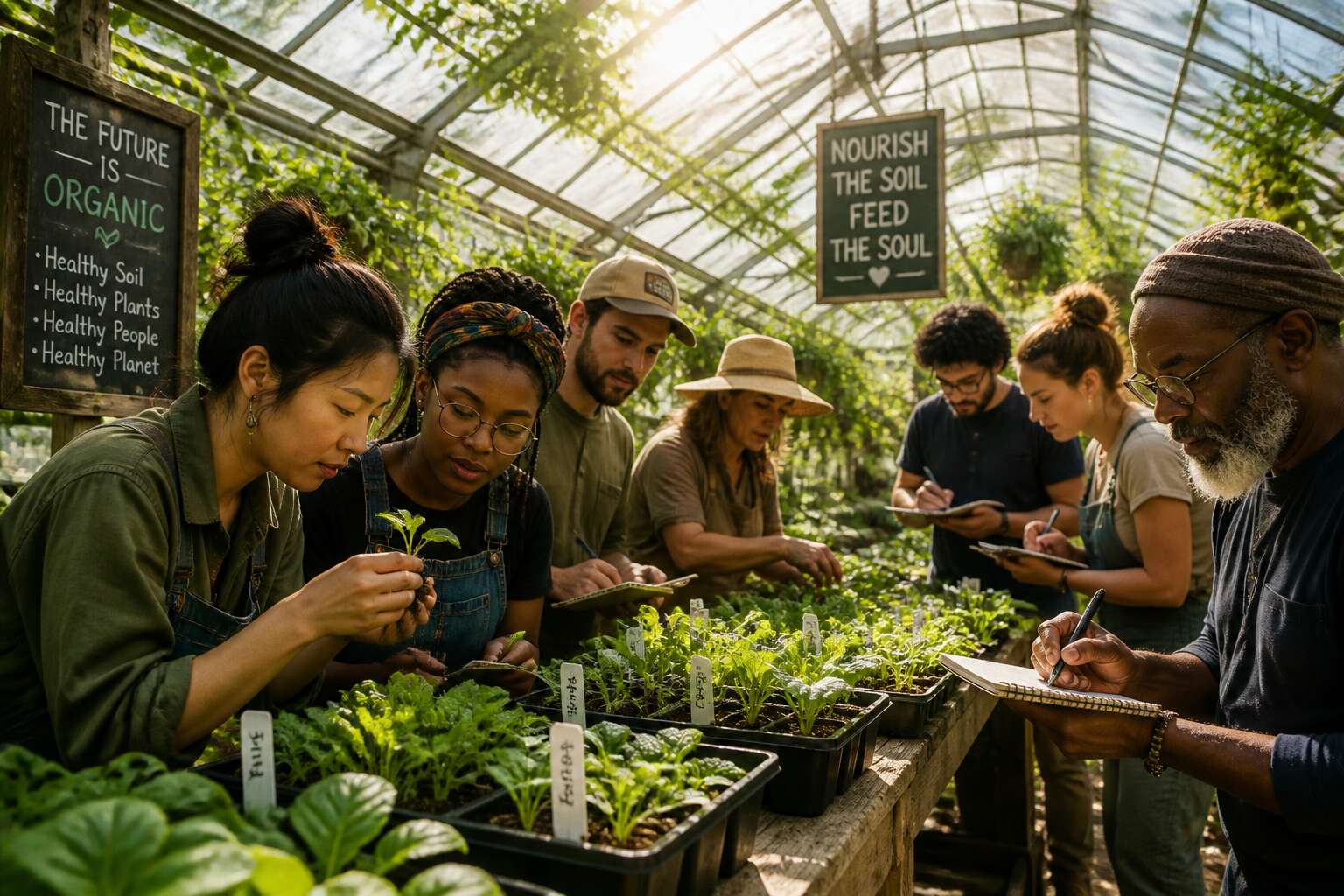
What to Expect from Hands-On Agricultural Training
The Value of Practical Experience
At an organic farming workshop, you will kneel in the soil and feel its texture. This direct contact converts abstract theory into lasting skills. Practical experience engages your senses and memory in ways that reading alone cannot achieve.
Expect these hands-on activities:
- Assessing soil health by touch and smell
- Mixing compost and observing decomposition
- Identifying beneficial insects in the field
Each task builds your confidence. I remember my first session and how planting a seedling changed my understanding entirely. What a difference it makes to handle living soil yourself! The value of practical experience lies in its permanence, staying with you long after the workshop concludes.
Typical Curriculum and Daily Schedule
South Africa’s organic sector has grown 12% year on year, yet skilled practitioners remain scarce. A typical organic farming workshop compresses months of learning into a few intense days.
The curriculum tracks the seasonal calendar. Mornings are spent in the field: soil sampling, seed sowing, and irrigation audits. Afternoons shift to the science behind the practice, covering nutrient cycling and biological pest control.
A representative day looks like this:
- 07:00: Field walk and crop scouting
- 09:00: Soil texture analysis and pH testing
- 11:00: Compost tea brewing demonstration
- 14:00: Pest identification and integrated management
The schedule adapts to local conditions. What matters is that every hour you spend at an organic farming workshop builds competence in the field, not just in a notebook.
Who Should Attend These Programs
Many arrive expecting a high tech indoor experience. They find the opposite, a working landscape that demands your full attention. The soil is the classroom and the weather sets the timetable. This is the reality of a modern organic farming workshop in South Africa, where theory is immediately tested against the local climate.
The demographics are as varied as the crops. You will stand next to commercial farmers diversifying their operations. You will share tools with recent graduates seeking practical skills. Gardeners and food suppliers attend to secure their supply chains and reduce input costs.
– Landowners exploring regenerative methods for degraded soils.
– Entrepreneurs planning new agri-business ventures.
– Extension officers and agricultural advisors.
Each spends the days in direct contact with the living system. The focus is on building a working relationship with the land, not just collecting a certificate. The outcome is a sharper eye for crop health and a clearer understanding of ecological balance. It is a demanding, rewarding experience that changes how you see food production.
How to Choose the Right Training for Your Goals
“The soil is the great connector,” writes Wendell Berry, “our lives go into it.” Attending an organic farming workshop in South Africa begins with accepting that premise. Expect your hands in the earth before lunch, testing tilth and moisture. The sensory feedback is immediate, unmediated by screens or slides.
Choose your program with as much care as you would a seed variety. The Western Cape’s Mediterranean climate demands a different syllabus than the summer rainfall regions of the Highveld. Look for trainers who have walked their own land through drought and deluge. The curriculum should include soil biology, water management, and the financial calculus of organic yields.
– Inspect the ratio of practical hours to classroom time.
– Ask about the specific crops covered in the region.
– Request references from previous participants.
– Confirm the size of the working farm used for demonstrations.
The right organic farming workshop calibrates your senses to the rhythm of the land. You leave with calluses and a ledger of tested skills, not just a folder of notes. Your goal is not to be told how to farm, but to be given the tools to observe, adapt, and thrive in a living system.
Core Techniques Taught in Sustainable Growing Courses
Soil Health and Composting Methods
South African soils lose an estimated 3 tons of topsoil per hectare annually to erosion, which makes composting methods essential knowledge for any grower. A well structured organic farming workshop dedicates considerable time to soil ecology, teaching participants how to read soil texture, test biological activity, and interpret humus content.
Core curriculum typically covers:
- Building thermophilic compost piles that reach internal temperatures of 55 to 65 degrees Celsius
- Brewing compost tea extracts for foliar feeding
- Managing vermicomposting systems with Eisenia fetida worms
- Calculating carbon to nitrogen ratios for different feedstocks
Participants in the organic farming workshop learn to balance moisture, aeration, and particle size so their piles break down efficiently. These practices directly improve water retention and nutrient availability in South African conditions, from sandy coastal soils to heavy inland clays.
Natural Pest Control and Crop Rotation
If you think pests are merely hungry, consider the looper caterpillar that devours a cabbage patch faster than a load-shedding schedule demolishes your evening plans. In any organic farming workshop, the real lesson is that nature has its own bouncers. We learn to recruit them instead of nuking everything with chemicals.
Natural pest control starts with understanding predator cycles, not panic. Ladybird larvae, parasitic wasps, and even certain nematodes become your unpaid security team. We also use trap crops like nasturtium to lure aphids away from cash crops. Then comes crop rotation, which confuses soil-borne diseases and starves persistent pests. A simple sequence might look like:
- Legumes to fix nitrogen
- Leafy greens to use it
- Root crops to break soil compaction
- Alliums to deter nematodes
Rotations are not a suggestion. They are a contract with your land. A solid organic farming workshop drills this rhythm into you, because monocropping is how you invite disaster to dinner.
Seed Saving and Nursery Management
Seed saving is a straightforward act of self reliance. In an organic farming workshop, you learn to choose seed from plants that survived your local conditions. Open pollinated varieties adapt over seasons. That process beats buying fresh seed every year.
Nursery management is about precision. Harden off seedlings to prevent transplant shock. Graft tomatoes onto resistant rootstock to block soil borne diseases. Balance water, light, and airflow with daily attention.
- Test germination rates before planting
- Label each tray with variety and date
- Water from below to cut damping off
The workshop turns these actions into routine. Soon your nursery produces tough starts that handle a Highveld hailstorm or a Cape Town gale!
Water Conservation and Irrigation Systems
In a country where drought cycles arrive without warning, the organic farming workshop treats water with precision. Sustainable growing courses teach you to read the landscape, to measure evapotranspiration rates before you turn a single tap. Drip lines deliver moisture to the root zone. Mulch layers slow evaporation and keep soil biology active beneath the crust.
You learn to design irrigation schedules around soil texture and weather forecasts, not guesswork. Rainwater harvesting systems channel roof runoff into storage tanks. Greywater, filtered and directed, becomes an asset.
Some techniques we practice:
- Ollas buried beside seedlings, weeping water slowly
- Wicking beds that draw moisture upward
- Hydrozones that group plants by thirst
Each method builds resilience into the system.
Livestock Integration and Permaculture Principles
When livestock enters the organic farming workshop, the focus shifts from soil and seeds to the animals that shape them. You learn to read animal behavior as a management tool. Rotational grazing moves herds through paddocks on a schedule that lets the veld recover fully between sessions. Chickens follow behind, spreading dung and scratching pests from the earth.
Permaculture principles structure these choices. Zones place high-maintenance animals close to the homestead. Sectors map wind, water, and wildlife paths across the property. Practical pairings emerge from this framework:
- Pigs till compacted ground when managed with portable fencing
- Ducks control snails and produce eggs from marginal ponds
- Manure feeds compost piles instead of becoming a disposal problem
The organic farming workshop shows that feed, fertilizer, and fieldwork come from the same animals. Each element carries several responsibilities, a principle that runs from the vegetable garden to the kraal.
Benefits of Participating in Ecological Farming Education
Building a Professional Network
Every ecological farmer knows that isolation is the silent killer of innovation. An organic farming workshop changes that by placing you in a room full of people who speak your language. You exchange more than just contact details; you trade hard-won insights about local market quirks and weather patterns.
My most valuable mentorship started with a casual conversation about cover crops during lunch. That one chat reshaped my entire approach to soil moisture! In a profession where trial and error is expensive, a professional network becomes your safety net.
Here is what these connections offer:
- Early warnings about pest outbreaks in your district
- Access to niche suppliers for smallholdings
- Collaborations on bulk seed orders
Such relationships compound over time, turning isolated growers into a resilient community. That is the true hidden curriculum of any reputable workshop.
Increasing Farm Productivity and Biodiversity
An organic farming workshop is where the pragmatic magic of agroecology meets the bottom line. We often treat productivity and biodiversity as opposing forces, but ecological farming education reveals them as symbiotic partners in the same dance. A farm that only chases yield strips the soil of its microbial life, forcing a dependency on synthetic inputs that get more expensive every season. Participating in a hands-on course flips that script. You learn to read the land as a living system, not a factory floor.
The stats are starting to back up the sentiment. A study from Stellenbosch University highlighted that regenerative practices can increase long-term yields by up to 79%, but the real win is the reduction in external costs. When you understand the biological drivers, you stop spending money on remedies for symptoms. You start investing in the health of the system itself.
This is where the concept of biodiversity stops being a fluffy ideal for conservationists and becomes a hard asset.
– Native flowering strips attract predatory wasps that control aphid populations naturally.
– Intercropping legumes with maize fixes atmospheric nitrogen, cutting fertilizer needs by nearly a third.
– Rotational grazing patterns mimic wild herds, which stimulates grass root growth and sequesters carbon simultaneously.
The integration is the point. During the practical sessions, you see how a diverse system buffers against the erratic weather patterns of the Western Cape or the intense heat of the Limpopo valley. One season, your cash crop might struggle, but the polyculture surrounding it ensures the soil structure remains intact and the beneficial insect populations persist. You are not just growing food; you are cultivating resilience.
Attending an organic farming workshop gives you the confidence to experiment with these complex interactions. You move away from the linear thinking of input and output and embrace the circular logic of ecology. The result is a farm that works hard for you while healing the land it stands on. In a country with such varied climates, this education is not a luxury, it is a survival mechanism for the soil and your profit margin. The honeybees might not appreciate the irony, but your bank balance certainly will.
Personal Well-Being and Community Engagement
There is a specific loneliness to farming that the uninitiated never see. It is not the solitude of the landscape, but the isolation of doubt. The organic farming workshop dismantles that solitude by placing you within a cohort of fellow practitioners who speak the language of soil, weather, and failure. The connection formed in the field, while your hands are buried in compost, is a potent antidote to the mental strain of decision making.
The psychological benefits are tangible. Participants frequently report a decline in anxiety associated with trial and error, because the shared knowledge base absorbs the risk. You are no longer the sole guardian of your plot’s secrets. You become part of a living library of experience.
This engagement filters into the wider community, creating resilient rural and peri-urban economies.
1. Shared tool libraries and cooperative seed banks reduce capital expenditure for all members.
2. Group buying power lowers the cost of organic inputs and biological controls.
3. Knowledge exchange regarding local pests and microclimates increases the speed of adaptation.
The emotional weight of the profession is lighter when you are anchored to a network of like-minded souls. In South Africa, where the land carries a heavy history, the act of healing it collectively offers a profound sense of purpose that transcends the individual. The workshop becomes a sanctuary for the mind, even as it equips you for the market. It is a rare space where well-being is treated as an input, not an output.
Career Opportunities in Green Agriculture
South Africa’s green economy is projected to create hundreds of thousands of new jobs by 2030. Most of those roles demand practical ecological knowledge. An organic farming workshop bridges the gap between classroom learning and on-farm employability.
Graduates move into positions as farm managers, compost specialists, or agricultural extension officers. The training builds verifiable competence in sustainable methods. Employers want people who can diagnose soil health, manage irrigation, and plan crop schedules independently.
- Agro-processing ventures require organic certification knowledge.
- Urban farming projects need trained coordinators.
- Supply chain roles favour candidates with production experience.
The organic farming workshop also supports entrepreneurship. Land reform beneficiaries and emerging farmers gain the operational skills to run commercial ventures. That is a direct path to economic independence in a sector with genuine demand.
Economic Savings through Self-Sufficiency
An organic farming workshop won’t just hand you a binder of theory. It will show you how to spend less money on things you can produce yourself. Seeds, seedlings, fertiliser, and pest control are all on the table when you learn ecological methods.
One graduate in Limpopo now grows her own seedling trays and brews her own compost tea. Her input costs dropped dramatically. That is self-sufficiency in action.
The practical savings appear in several places:
– Buying seeds once and saving them for next season
– Producing compost on site instead of purchasing soil conditioners
– Reducing water bills through smart irrigation design
The workshop teaches you to see the farm as a closed loop. Outputs become inputs. Your wallet stays heavier and your soil stays healthier. That economic resilience matters as much as the yield itself.
Certification and Credentialing Pathways
In South Africa, formal recognition for ecological farming skills is growing. An organic farming workshop can serve as the first step toward credible certification. Bodies like the South African Qualifications Authority recognise modular training that builds toward full qualifications.
Certification pathways vary by province and crop type. Completing an accredited module gives you documentation that carries weight with financiers and buyers. The options include:
- Unit standards linked to national agricultural qualifications
- Private certifiers aligned with international organic standards
- Short course credentials from agricultural colleges
Each pathway suits different goals. Export-oriented growers may prefer global certification. Local market farmers often choose municipal recognition. This layered approach means you can start with one weekend workshop and build credentials over time.
How to Prepare for and Follow Up After the Training
Essential Gear and Supplies to Bring
Arriving at an organic farming workshop with the wrong boots is a mistake you only make once. Mud seeps in, feet go cold, and focus shifts from compost ratios to discomfort. Before you leave home, study the schedule and map out where you will park and where the shaded seating is. Pack a change of socks and a light rain jacket, because Cape winters have a habit of surprising the most prepared attendee.
For the field sessions, keep your kit light but complete:
- Sturdy, waterproof boots with good grip
- A folding hand trowel and pruning knife
- Notebook and waterproof pens
- Refillable water bottle and sunscreen
- A magnifying loupe for inspecting leaves
Label your tools with tape and your name, as communal tables get chaotic by midday. Follow up within three days. Send a short note to the hosts thanking them and asking one specific question from your notes. Practice one technique at home before the next session. That quiet, deliberate repetition is where the real learning from an organic farming workshop happens.
Setting Learning Objectives in Advance
Most attendees leave an organic farming workshop with a full notebook and an empty plan. The difference between a pleasant day and a real shift in practice starts before you arrive. Write down three specific outcomes you want, such as identifying the cause of yellowing leaves or comparing two compost systems. This turns passive listening into active investigation.
During the sessions, tie each demonstration back to those objectives. When a facilitator explains a technique, ask yourself how it would work on your soil type or with your water supply. Note only the details that answer your questions.
- Review your notes the same evening
- Select one method to test in a small plot
- Set a reminder to evaluate results after one month
After the organic farming workshop, resist the urge to enroll in another course. Apply what you learned. Send the host a concise question about a point that puzzled you, then block out time to practice. That follow-up is where knowledge becomes skill.
Taking Effective Notes and Documenting Practices
Only 1 in 10 attendees of an organic farming workshop ever looks at their notes again. That is a sad statistic, because the real value sits in the details you capture. Bring a notebook with a grid layout. Sketch beds, trace drip lines, and annotate with your own conditions. Do not transcribe every slide. Instead, record what differs from your current methods.
Documenting practices extends beyond notes. Photograph plants, pests, and soil color. Record application rates and weather conditions. Use a consistent naming system for images.
After the workshop, transfer these observations into a simple spreadsheet or logbook. Include date, crop, action, and result. A list of follow-up items might include:
- Test the compost ratio on one bed.
- Monitor leaf yellowing after the foliar spray.
- Compare irrigation timing against rainfall data.
This documentation turns a single organic farming workshop into a season of decisions.
Implementing New Skills on Your Own Land
Before you travel to an organic farming workshop, make a map of your land. Mark sun patterns, wind direction, and water sources. This baseline turns generic advice into actionable steps for your specific conditions. Walk every boundary and note where weeds thrive or soil compacts.
After the training, resist the urge to overhaul everything at once. Choose one technique, such as a new compost layering method, and trial it on a small plot. Observe for two weeks. Record rainfall, temperature, and plant response. Adjust the method to suit your soil type and microclimate.
- Compare your land map with workshop recommendations.
- Select one skill to implement first.
- Schedule a weekly review of progress.
This focused approach ensures the organic farming workshop changes how you work on your land.
Joining Alumni Groups and Ongoing Support
Contact the instructors before attending. Ask which topics they emphasise most and whether they recommend preparatory readings. This correspondence sharpens your focus and warms the relationship before you arrive.
After the training, alumni groups provide ongoing support that turns a single organic farming workshop into a lasting resource. Members trade regional observations, pest alerts, and seed varieties suited to South African conditions. They also post field photos from their own properties, offering practical context that classroom notes cannot capture.
Many organisers follow up with structured opportunities:
- Quarterly webinars on seasonal techniques
- WhatsApp groups for rapid troubleshooting
- Regional meetups for field demonstrations
I have come to rely on these networks during unpredictable weather. The knowledge flows in both directions, and that exchange keeps everyone grounded in real conditions.

0 Comments